
Introduction
This shadow size experiment question is a common Primary Science application question on light and shadows. Many students know that the distance between a light source and an object affects shadow size, but they may get confused when reading a results table. Once you understand the relationship clearly, this shadow size experiment question becomes much easier to answer.
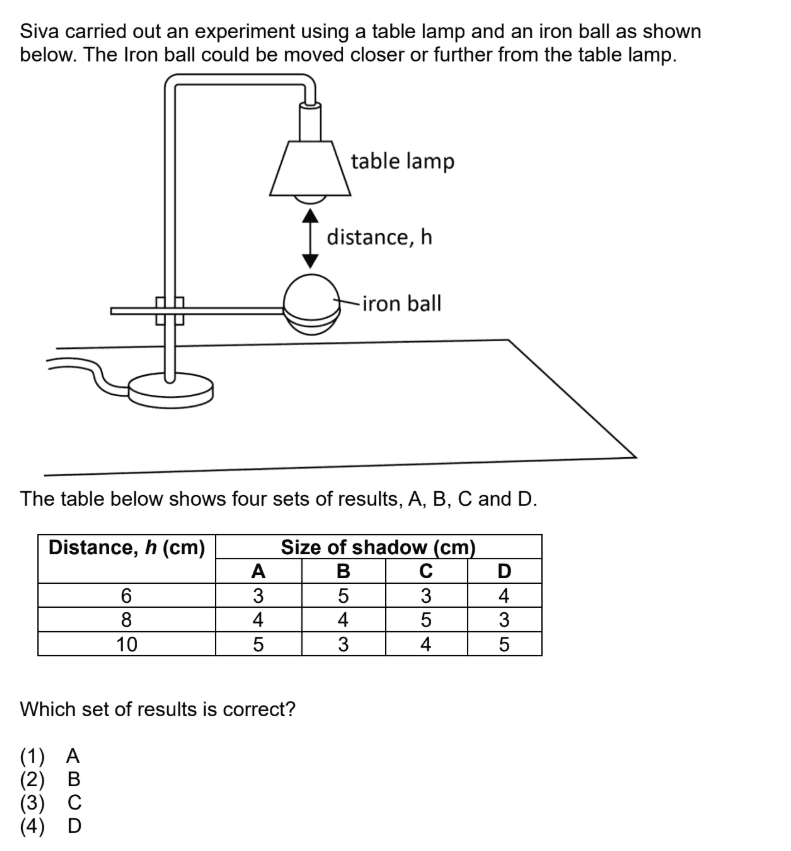
The Question / Scenario Explanation
Source: P5 Question 5
Question (as shown): Siva carried out an experiment using a table lamp and an iron ball. The iron ball could be moved closer or further from the table lamp. The table shows four sets of results, A, B, C and D. Which set of results is correct?
Distances shown:
6 cm
8 cm
10 cm
Sets of results:
A: 3, 4, 5
B: 5, 4, 3
C: 3, 5, 4
D: 4, 3, 5
Step-by-Step Solution / Explanation
Step 1: Identify what changes in the experiment
The distance \(h\) between the table lamp and the iron ball changes.
As the iron ball is moved further from the table lamp, the light source is farther away from the object.
This is the key idea in the shadow size experiment.
Step 2: Recall the science concept
When an object is closer to the light source, its shadow is usually larger.
When an object is further from the light source, its shadow becomes smaller.
So as the distance increases from 6 cm to 8 cm to 10 cm, the size of the shadow should decrease.
Step 3: Check which set matches the correct pattern
We need the shadow size to go down as the distance goes up.
Look at each set:
- A: 3, 4, 5 → increasing, so not correct
- B: 5, 4, 3 → decreasing, so correct
- C: 3, 5, 4 → mixed pattern, so not correct
- D: 4, 3, 5 → mixed pattern, so not correct
Only set B shows the correct trend for the shadow size experiment.
✅ Final Answer: Option (2), B
Step 4: Explain the result clearly
At 6 cm, the iron ball is closest to the lamp, so the shadow should be the biggest.
At 10 cm, the iron ball is furthest from the lamp, so the shadow should be the smallest.
That is why the correct sequence is 5, 4, 3, which is set B.
Key Concepts Students Must Know
- In a shadow size experiment, the distance between the light source and the object affects shadow size.
- The closer the object is to the light source, the bigger the shadow.
- The further the object is from the light source, the smaller the shadow.
- Science tables often test whether students can match results to the correct trend.
- Always look for the pattern, not just individual numbers.
Exam Tips / Common Mistakes
Exam Tips
- Underline what is changing in the experiment. Here, it is the distance \(h\).
- Ask yourself whether the shadow should get bigger or smaller as the object moves away.
- For a shadow size experiment, focus on the trend across the whole table.
- Eliminate answer choices that do not follow a logical increase or decrease.
Common Mistakes
- Thinking the shadow gets bigger when the object is moved further from the lamp.
- Looking at only one row instead of checking the full pattern from 6 cm to 10 cm.
- Choosing a mixed pattern like C or D without applying the science concept.
- Forgetting that the light source stays the same while only the distance changes in the shadow size experiment.
Parent Insight
This shadow size experiment question is a good example of how Science tests both concept understanding and data interpretation. Many children know simple facts about light, but they lose marks when they must apply those facts to a results table. Regular practice with table-based Science questions helps students become more confident and accurate in PSLE-style exams.
Conclusion
In this shadow size experiment, the shadow should become smaller as the iron ball moves further from the table lamp. That means the correct pattern is \(5, 4, 3\), which is set B. So the correct answer is option (2).
Visit our PSLE Science homepage: Click Here…
Read more PSLE Science worked examples here: Click Here…
Start here (limited slots weekly):
Free Trial: Click Here…
Enroll: Click Here…
Explore our main tuition brand approach here: Click Here… .