
Introduction
This railway track gaps question is a common Primary Science application question on heat and expansion. Many students know that metals change size when heated, but they may not connect that idea to real-life objects like railway tracks. Once you understand why railway track gaps are needed, this question becomes much easier to answer correctly.
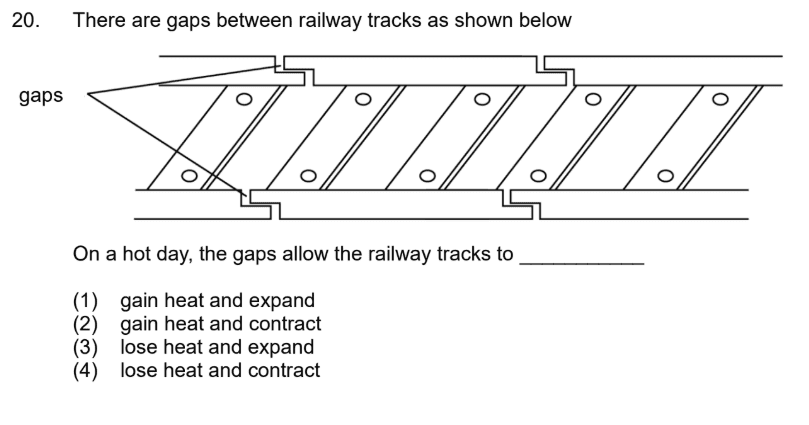
The Question / Scenario Explanation
Source: P5 Question 4
Question (as shown): There are gaps between railway tracks as shown below.
On a hot day, the gaps allow the railway tracks to ________
Options:
(1) gain heat and expand
(2) gain heat and contract
(3) lose heat and expand
(4) lose heat and contract
Step-by-Step Solution / Explanation
Step 1: Recall the science concept
Railway tracks are usually made of metal.
Metals gain heat when the weather is hot. When metals gain heat, they expand.
This is the key idea behind railway track gaps.
Step 2: Apply the concept to the tracks
On a hot day, the railway tracks absorb heat from the surroundings.
As they gain heat, the metal tracks become slightly longer. That means they expand.
The gaps are left between the tracks so there is space for this expansion to happen safely.
Step 3: Choose the correct answer
The correct option is:
(1) gain heat and expand
✅ Final Answer: Option (1) gain heat and expand
Step 4: Explain why the other options are wrong
Option (2) is wrong because when metals gain heat, they do not contract. They expand.
Option (3) is wrong because losing heat usually causes metals to contract, not expand.
Option (4) is wrong because it describes what happens when metals cool down, not what happens on a hot day.
So for this railway track gaps question, only option (1) matches the science concept correctly.
Key Concepts Students Must Know
- Most materials, including metals, expand when heated and contract when cooled.
- Railway tracks are made of metal, so they become longer on hot days.
- Railway track gaps are left to allow space for expansion.
- Without gaps, expanding tracks may bend, press against one another, or become damaged.
- Primary Science questions often test how a science concept is applied in real life.
Exam Tips / Common Mistakes
Exam Tips
- Underline the words hot day before choosing an answer.
- Ask yourself what happens to metal when it is heated.
- For a railway track gaps question, remember the simple rule: hot means gain heat and expand.
- Eliminate answers that mix the wrong heat change with the wrong size change.
Common Mistakes
- Choosing gain heat and contract because of confusion between heating and cooling effects.
- Missing the words on a hot day and choosing an option about losing heat instead.
- Memorising “expand” without linking it correctly to gaining heat.
- Not realising that railway track gaps are a real-life example of heat expansion.
Parent Insight
This railway track gaps question is useful because it teaches children how Science applies beyond the classroom. Students may memorise that materials expand when heated, but real understanding comes when they can explain why engineers leave spaces between metal tracks. Questions like this build stronger concept application and help children answer PSLE-style Science questions more confidently.
Conclusion
In this railway track gaps question, the tracks are made of metal, and metal expands when it gains heat. That is why the gaps are needed on a hot day. The correct answer is option (1) gain heat and expand.
Visit our PSLE Science homepage: Click Here…
Read more PSLE Science worked examples here: Click Here…
Start here (limited slots weekly):
Free Trial: Click Here…
Enroll: Click Here…
Explore our main tuition brand approach here: Click Here… .