
Introduction
This light sensor shadow question is a strong Primary Science application question because it combines light intensity, shadow size, and movement of objects in one set-up. Many students know that moving a torch changes shadow size, but they get confused when they also have to explain the changing sensor reading. Once the set-up is read carefully, this light sensor shadow question becomes much easier to solve.
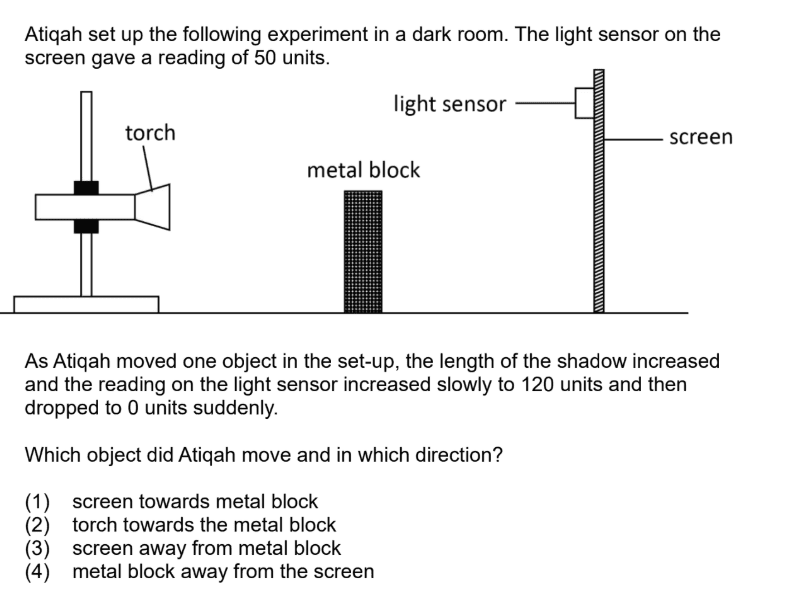
The Question / Scenario Explanation
Source: P5 Question 6
Question (as shown): Atiqah set up an experiment in a dark room. The light sensor on the screen gave a reading of \(50\) units.
As Atiqah moved one object in the set-up, the length of the shadow increased and the reading on the light sensor increased slowly to \(120\) units and then dropped to \(0\) units suddenly.
Which object did Atiqah move and in which direction?
Options:
(1) screen towards metal block
(2) torch towards the metal block
(3) screen away from metal block
(4) metal block away from the screen
Step-by-Step Solution / Explanation
Step 1: Focus on the two clues in the question
There are two very important clues in this light sensor shadow question:
- the shadow length increased
- the light sensor reading increased slowly from \(50\) to \(120\), then suddenly dropped to \(0\)
We need one option that explains both changes correctly.
Step 2: Recall how shadow size changes
When the light source moves closer to the object, the shadow formed becomes bigger.
So if the torch moves towards the metal block, the shadow on the screen will become longer or larger.
This matches the first clue.
Step 3: Explain the light sensor reading
When the torch moves closer to the metal block and the screen, the light reaching the screen becomes stronger. So the light sensor reading can increase gradually.
However, as the shadow becomes larger at the same time, there will come a point when the growing shadow reaches the light sensor.
Once the shadow covers the sensor, the reading will suddenly become \(0\).
This matches the second clue exactly.
Step 4: Choose the correct answer
The only option that explains both the increasing shadow length and the sensor reading rising first, then suddenly dropping to zero is:
Option (2) torch towards the metal block
✅ Final Answer: Option (2) torch towards the metal block
Step 5: Why the other options are wrong
Option (1) screen towards metal block is not the best answer because moving the screen changes the shadow size, but it does not fit the gradual increase in sensor reading followed by a sudden drop as clearly as moving the torch does.
Option (3) screen away from metal block would increase the shadow size, but it would not explain the sensor reading increasing in the same clear way.
Option (4) metal block away from the screen moves the block closer to the torch, but the option given is less direct for explaining the gradual light increase at the screen compared with moving the torch itself towards the metal block.
So for this light sensor shadow question, option \(2\) is the best match.
Key Concepts Students Must Know
- When the light source is closer to the object, the shadow becomes bigger.
- A light sensor gives a higher reading when more light reaches it.
- If a shadow covers the light sensor, the reading can drop to zero.
- In a light sensor shadow question, students must explain both the shadow change and the light reading change together.
- Science questions often test whether one movement can explain multiple observations.
Exam Tips / Common Mistakes
Exam Tips
- Underline all observations before looking at the options.
- Do not focus only on shadow size. Also check what happens to the light sensor reading.
- For a light sensor shadow question, ask: which movement makes the shadow bigger and changes the amount of light reaching the sensor?
- Choose the option that explains the full sequence, not just one part of it.
Common Mistakes
- Choosing an option only because the shadow gets bigger, while ignoring the sensor reading pattern.
- Forgetting that a sensor reading of \(0\) means the sensor is no longer receiving light.
- Not noticing that the reading increased first before dropping suddenly.
- Treating the shadow clue and sensor clue as separate questions instead of linking them in the same light sensor shadow set-up.
Parent Insight
This light sensor shadow question is a strong example of higher-level Primary Science thinking. Students cannot rely on memorising one fact about shadows. They must connect several ideas at once: light intensity, distance, shadow size, and what a sensor reading means. Practising these observation-based questions helps children build deeper understanding and improve their confidence in Science MCQs.
Conclusion
In this light sensor shadow question, the shadow became longer, while the light sensor reading rose from \(50\) to \(120\) and then suddenly fell to \(0\). This happens when the torch moves towards the metal block. The light becomes stronger at first, but once the enlarged shadow covers the sensor, the reading drops to zero. So the correct answer is option (2).
Visit our PSLE Science homepage: Click Here…
Read more PSLE Science worked examples here: Click Here…
Start here (limited slots weekly):
Free Trial: Click Here…
Enroll: Click Here…
Explore our main tuition brand approach here: Click Here… .