
Introduction
Many students enjoy eating ice cream, but few stop to think about the Science behind it. When holding a metal spoon in ice cream, the ice cream melts, but the spoon does not. This everyday situation is a great way to understand heat transfer.
In PSLE Science, students need to know that heat moves from a hotter region to a cooler region. They also need to understand conduction, which is the transfer of heat through direct contact. This question helps students connect both ideas to real life.
Once students understand the direction of heat transfer and the properties of different materials, this concept becomes much easier to explain.
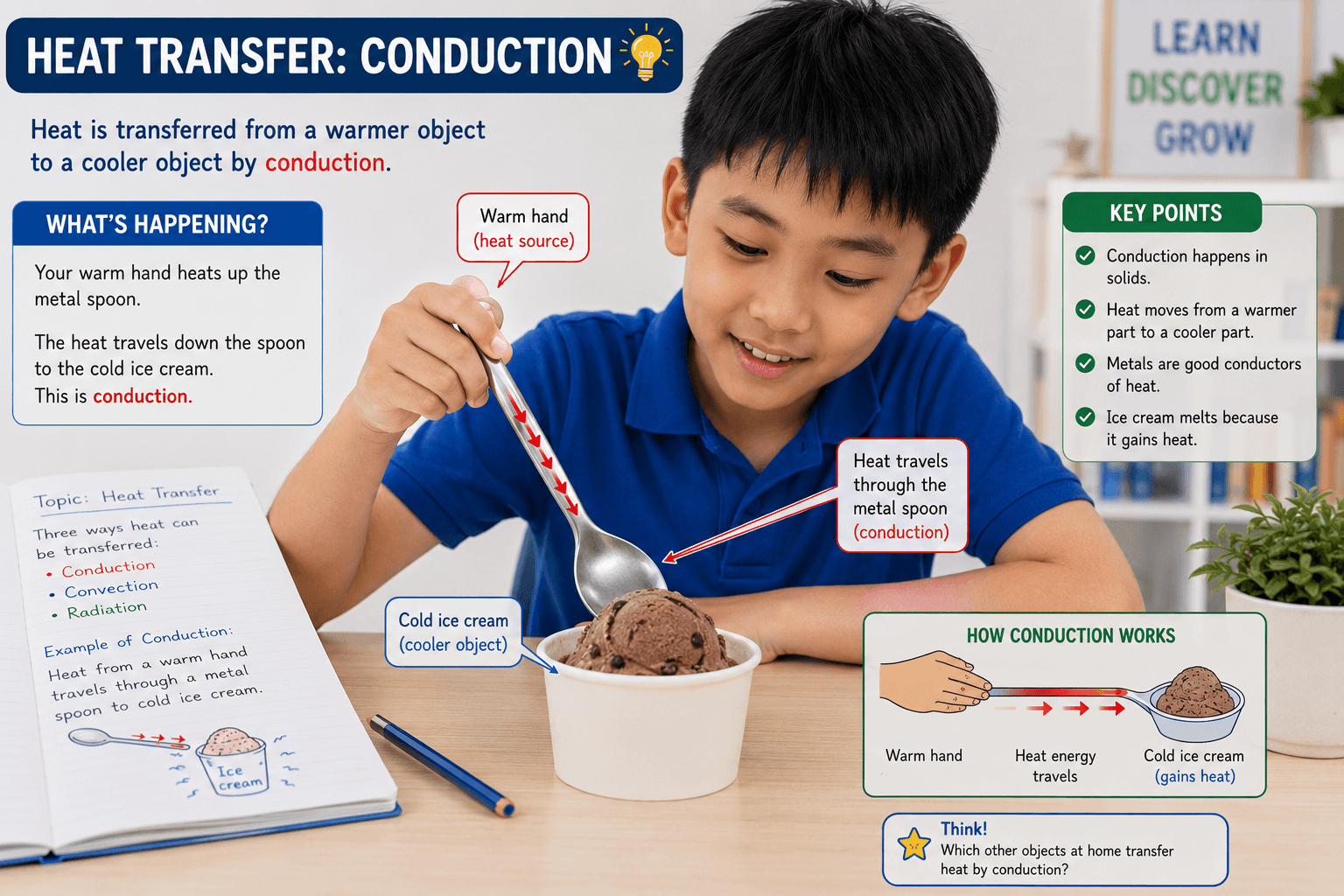
The Question / Scenario Explanation
Source: Why Does Your Ice Cream Melt But Your Spoon Doesn’t?
The video presents a simple but interesting question: when you hold a metal spoon in your hand and place it in ice cream, why does the ice cream melt while the spoon does not?
The screenshots show two important ideas:
- Heat always travels from a hotter region to a cooler region.
- Conduction is the transfer of heat through direct contact.
In this situation:
- Your hand is warmer.
- The metal spoon is in contact with your hand and the cold ice cream.
- Heat is transferred through the spoon into the colder ice cream.
This causes the ice cream to melt. However, the spoon itself does not melt because metal has a much higher melting point than ice cream.
Step-by-Step Solution / Explanation
Step 1: Know the Direction of Heat Transfer
The first idea students must remember is that heat transfer always happens from a hotter region to a cooler region.
In this example:
- Your hand is warmer than the spoon and the ice cream.
- The ice cream is much colder than your hand.
So heat moves from your warm hand towards the colder ice cream.
Step 2: Understand Conduction
The type of heat transfer involved here is conduction. Conduction happens when heat is transferred through direct contact.
Your hand touches the metal spoon, and the spoon touches the ice cream. Because of this direct contact, heat can move through the spoon and into the ice cream.
Metals are good conductors of heat, so a metal spoon allows heat to travel easily.
Step 3: Explain Why the Ice Cream Melts
The ice cream melts because it receives heat from the warmer surroundings through the spoon.
When the ice cream gains heat energy, it starts to change state from a solid to a liquid. This is why the ice cream becomes softer and begins to melt.
So, the melting happens because the ice cream is absorbing heat.
Step 4: Explain Why the Spoon Does Not Melt
This is the part many students miss. Although the spoon is involved in heat transfer, it does not melt.
The reason is that a metal spoon has a very high melting point. The heat from your hand is not nearly enough to melt the metal.
Ice cream melts easily because its melting point is low. Metal does not melt under normal everyday conditions because it needs a much higher temperature.
Step 5: Put the Full Explanation Together
A complete PSLE Science explanation would be:
Heat is transferred from the warmer hand to the colder ice cream through the metal spoon by conduction. The ice cream melts because it gains heat. The spoon does not melt because metal has a much higher melting point than ice cream.
Step 6: Connect It to Daily Life
This same Science idea can be seen in many daily situations:
- A metal spoon in hot soup becomes hot.
- An ice cube melts faster when held in your hand.
- A cold canned drink becomes warmer when left on a table.
These examples all show how heat transfer works from a hotter place to a cooler place.
Key Concepts Students Must Know
- Heat moves from hot to cold: Heat always travels from a hotter region to a cooler region.
- Conduction needs direct contact: Heat is transferred when objects touch each other.
- Metals are good conductors: A metal spoon allows heat to move through it easily.
- Ice cream melts because it gains heat: It changes from solid to liquid when heated.
- Different substances have different melting points: Ice cream melts easily, but metal needs a much higher temperature to melt.
Exam Tips / Common Mistakes
Exam Tips
- Always state the direction of heat transfer clearly: from warmer to cooler.
- Use the keyword conduction when direct contact is involved.
- Mention that metals are good conductors of heat when explaining metal objects.
- If a question asks why something melts, explain that it gains heat energy.
- If a question asks why another object does not melt, explain its higher melting point.
Common Mistakes
- Saying that cold travels from the ice cream to the spoon.
- Forgetting to mention conduction.
- Writing that the spoon does not melt because it does not receive heat.
- Not explaining the difference in melting points between ice cream and metal.
- Using everyday words only and missing key Science terms.
A common exam trap is writing that “coldness moves into the spoon”. In Science, we say heat moves from the warmer object to the cooler one. Students should always describe the movement of heat, not cold.
Parent Insight
Science becomes easier for children when they can connect concepts to everyday life. Questions like this are powerful because they start from a familiar experience and lead to a clear Science explanation.
Parents can help by asking simple questions at home such as:
- “Which is warmer, your hand or the ice cream?”
- “How does the heat move?”
- “Why is a metal spoon better at transferring heat than a plastic spoon?”
- “Why does the ice cream melt, but not the spoon?”
These simple conversations help children understand heat transfer more deeply instead of just memorising definitions.
Conclusion
Heat transfer explains why the ice cream melts but the spoon does not. Heat moves from your warmer hand to the colder ice cream through the metal spoon by conduction.
The ice cream melts because it gains heat and has a low melting point. The spoon does not melt because metal has a much higher melting point and cannot be melted by the small amount of heat from your hand.
When students remember the direction of heat transfer, the idea of conduction, and the difference in melting points, they can answer this type of PSLE Science question with much more confidence.
Visit our homepage: Click Here…
Read more on our blog: Click Here…
Start here (limited slots weekly):
Free Trial: Click Here…
Enroll: Click Here…
Explore our main tuition brand approach here: Click Here… .