
Introduction
A simple green leaves explanation can help students understand an important Primary Science idea about light and plants. Many children assume that leaves are green because plants “use” green light the most. In fact, the opposite is closer to the truth.
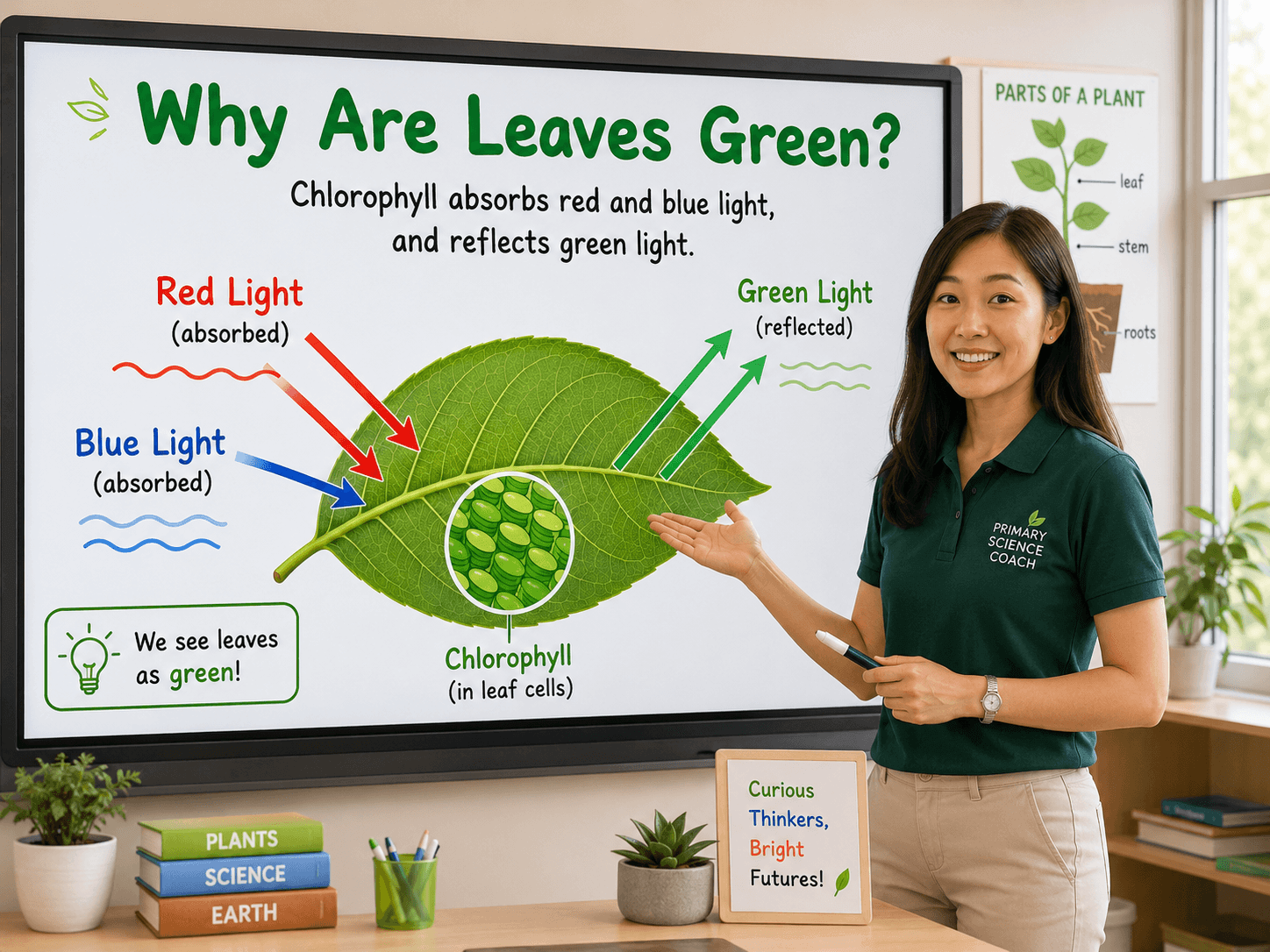
Leaves look green because a pigment called chlorophyll absorbs some colours of light and reflects green light into our eyes. This is why we see the leaf as green.
Understanding this idea is useful in PSLE / Primary Science because it connects several topics together, including light, absorption, reflection and photosynthesis.
The Question / Scenario Explanation
Source: Leaves are green because they reject green.
This statement may sound surprising at first. After all, if a leaf is green, many students expect green to be the colour it keeps. However, the colour we see is usually the colour of light that is reflected rather than absorbed.
Sunlight contains many colours. In Primary Science, students often learn that white light is made up of different colours, such as red, orange, yellow, green, blue and violet.
Inside a leaf is a pigment called chlorophyll. Chlorophyll is important for photosynthesis because it traps light energy for the plant to make food.
Chlorophyll absorbs mainly red light and blue light, but reflects green light. That reflected green light enters our eyes, so the leaf appears green.
This is the core green leaves explanation that students should remember.
Step-by-Step Solution / Explanation
Step 1: Understand That Sunlight Contains Many Colours
Although sunlight may look white or slightly yellow, it is actually made up of many colours of light.
These colours form the visible spectrum, including red, orange, yellow, green, blue and violet.
This means that when sunlight shines on a leaf, many different colours reach the leaf at the same time.
Step 2: Identify the Role of Chlorophyll
Leaves contain a green pigment called chlorophyll.
Chlorophyll helps the plant absorb light energy. The plant then uses this energy during photosynthesis to make food.
In other words, chlorophyll is not just responsible for the leaf’s colour. It is also important for the plant’s survival.
Step 3: Know Which Colours Are Absorbed
Chlorophyll absorbs mainly red light and blue light.
These absorbed colours provide energy that helps the plant carry out photosynthesis.
In science questions, the keyword absorbed is important because it shows that the light energy is taken in by the leaf.
Step 4: Know Which Colour Is Reflected
Chlorophyll reflects green light.
The reflected green light travels into our eyes. That is why the leaf appears green to us.
So when students ask, “Why is the leaf green?”, the answer is not “because it absorbs green light.” The more accurate answer is:
The leaf looks green because green light is reflected by the leaf into our eyes.
Step 5: Link This to Photosynthesis
Photosynthesis is the process by which plants make food.
For photosynthesis to happen, plants need light energy. Chlorophyll helps trap this energy by absorbing suitable colours of light.
This is why the green leaves explanation is linked closely to the topic of photosynthesis in Primary Science.
Step 6: Relate the Concept to Everyday Observation
When students look at grass, trees or potted plants, they are seeing green light reflected from the leaves.
This is a useful real-life reminder that the colour of an object often depends on the colour of light it reflects.
For example:
- a red object looks red because it reflects red light;
- a blue object looks blue because it reflects blue light; and
- a green leaf looks green because it reflects green light.
This helps students connect light concepts with everyday life.
Key Concepts Students Must Know
- Chlorophyll: A green pigment in leaves that helps absorb light energy for photosynthesis.
- Absorb: To take in light energy.
- Reflect: To bounce light off a surface.
- Visible light: White light is made up of different colours.
- Colour seen: The colour we see is usually the colour that is reflected into our eyes.
- Photosynthesis: The process plants use to make food with the help of light energy.
For science answering, students should use clear keywords such as chlorophyll, absorbs, reflects and photosynthesis.
Exam Tips / Common Mistakes
Exam Tips
- When explaining why leaves are green, mention both chlorophyll and green light reflected.
- Use complete science reasoning, not just one-word answers.
- If the question asks about the function of chlorophyll, state that it absorbs light energy for photosynthesis.
- Link light and colour questions to what reaches the eye.
- Underline science keywords during revision so you remember the exact wording.
Common Mistakes
- Saying leaves absorb green light: This is inaccurate. Leaves mainly reflect green light.
- Saying leaves are green “just because of chlorophyll”: Students should explain that chlorophyll reflects green light into our eyes.
- Forgetting to mention light: The explanation must involve colours of light, not only the plant itself.
- Confusing reflection with absorption: Reflected light is seen. Absorbed light is taken in.
- Leaving out photosynthesis: If the question asks about chlorophyll’s role, students should connect it to making food.
Parent Insight
Science understanding often becomes stronger when children realise that everyday things are connected to scientific ideas. A green leaf may seem ordinary, but it is actually a great example of how light and living things interact.
Parents can make this learning more meaningful by asking simple questions such as, “Why do you think the leaf looks green?” or “If green is reflected, which colours are absorbed?”
These small conversations help children practise scientific reasoning instead of memorising one sentence without understanding it.
Conclusion
This green leaves explanation can be summarised simply: leaves look green because chlorophyll reflects green light into our eyes, while absorbing mainly red and blue light.
At the same time, chlorophyll plays an important role in photosynthesis by helping the plant trap light energy to make food.
So the next time students see a green plant, they can remember an important Primary Science idea: the colour they see is the colour being reflected.
Visit our Primary Science homepage: Explore MasterScience
Read more Science learning guides: Visit Our Science Blog
Start here (limited slots weekly):
Free Trial: Click Here…
Enroll: Click Here…
Explore our main tuition brand approach here: Click Here…