
Introduction
Many students think evaporation and boiling are the same because both involve water changing into water vapour. However, in PSLE Science, evaporation boiling questions require students to explain the differences clearly using the right keywords.
Evaporation can happen at any temperature and only takes place at the surface of the liquid. Boiling happens only at a fixed temperature, called the boiling point, and takes place throughout the liquid with bubbles forming.
Once students understand these key differences, evaporation boiling questions become much easier to answer accurately in exams.
The Question / Scenario Explanation
Source: Evaporation vs boiling — same thing?
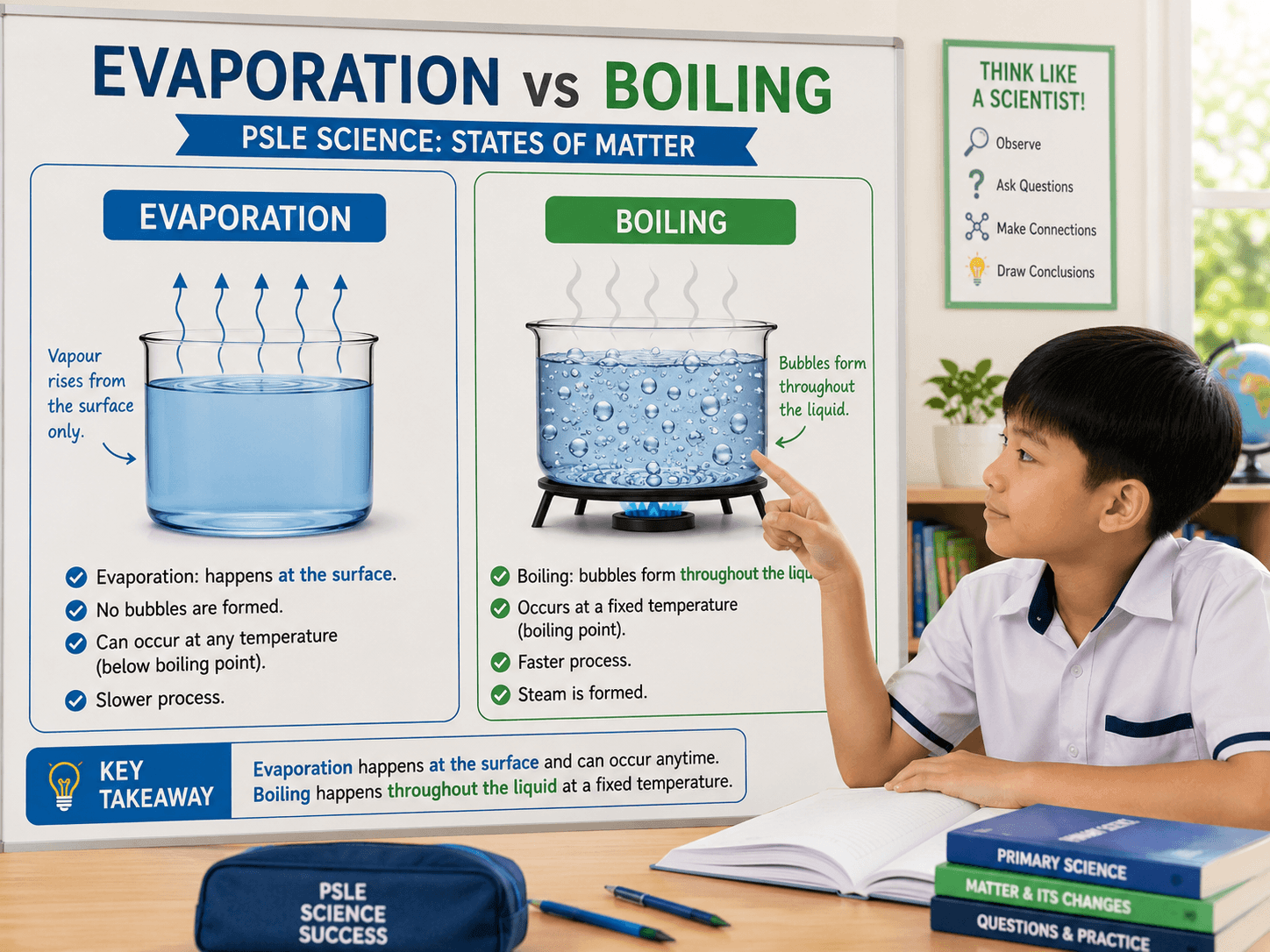
The screenshots compare evaporation and boiling. The first diagram shows evaporation happening at the surface of water. Surface particles gain enough energy and escape into the air as water vapour.
The next screenshots show boiling, where water reaches \(100^\circ\text{C}\). At this point, bubbles form not only at the surface but throughout the liquid.
The important comparison is:
- Evaporation: happens at any temperature, only at the surface, slow process, no bubbles.
- Boiling: happens at the boiling point, throughout the liquid, rapid process, bubbles form.
Students must avoid vague answers like “the water dried up”. A better Science answer is that the water gained heat from the surroundings or the Sun and evaporated.
Step-by-Step Solution / Explanation
Step 1: Understand What Evaporation Means
Evaporation is the change of state from liquid to gas at the surface of a liquid.
It can happen at any temperature. This means water does not need to reach \(100^\circ\text{C}\) before evaporation can take place.
For example, a puddle of water can slowly disappear on a sunny day even though it is not boiling. This is because water at the surface gains heat and changes into water vapour.
Step 2: Know Where Evaporation Happens
Evaporation happens only at the surface of the liquid.
The particles at the surface gain enough energy to escape into the air. This is why the diagram shows surface particles leaving the water.
A good PSLE Science sentence would be:
Water at the surface gained heat and evaporated into water vapour.
Step 3: Understand What Boiling Means
Boiling is also a change of state from liquid to gas, but it is different from evaporation.
Boiling happens only when the liquid reaches its boiling point. For water, the boiling point is \(100^\circ\text{C}\) under normal conditions.
At this temperature, water changes into water vapour rapidly.
Step 4: Know Where Boiling Happens
Boiling happens throughout the entire liquid, not just at the surface.
This is why bubbles can be seen forming inside the water and rising to the surface. These bubbles contain water vapour.
A good PSLE Science sentence would be:
Boiling occurs at the boiling point throughout the liquid, with bubbles forming rapidly.
Step 5: Compare Evaporation and Boiling Clearly
Students should compare evaporation and boiling using specific points:
- Temperature: Evaporation happens at any temperature, while boiling happens only at the boiling point.
- Location: Evaporation happens only at the surface, while boiling happens throughout the liquid.
- Speed: Evaporation is slower, while boiling is rapid.
- Bubbles: Evaporation has no bubbles, while boiling has bubbles.
This comparison is very useful for evaporation boiling exam questions.
Step 6: Use the Right Keywords
The video reminds students not to simply write “the water dried up”. This is too vague for Science exams.
Instead, students should write:
The water gained heat from the Sun and evaporated into water vapour.
This answer is stronger because it explains the cause and uses the correct Science keyword, evaporated.
Step 7: Connect It to Real Life
Evaporation and boiling happen in daily life.
- Wet clothes dry because water evaporates from the surface of the clothes.
- A puddle becomes smaller on a sunny day because water evaporates.
- Water in a kettle boils when it reaches its boiling point.
- Bubbles form in boiling water because water vapour is produced throughout the liquid.
These examples help students see that evaporation boiling concepts are not just textbook facts. They happen around us every day.
Key Concepts Students Must Know
- Evaporation happens at any temperature: Water does not need to reach boiling point before evaporation can occur.
- Evaporation happens only at the surface: Only surface particles escape into the air.
- Boiling happens at the boiling point: For water, this is \(100^\circ\text{C}\) under normal conditions.
- Boiling happens throughout the liquid: Bubbles form inside the liquid and rise to the surface.
- Correct keywords matter: Students should use words like “evaporated”, “water vapour”, “boiling point”, “surface”, and “bubbles”.
Exam Tips / Common Mistakes
Exam Tips
- When explaining evaporation, mention that it happens at the surface of the liquid.
- When explaining boiling, mention that it happens throughout the liquid.
- Use “boiling point” when the question is about boiling.
- Use “water vapour” when describing water changing into gas.
- In open-ended questions, explain what gained heat and what change of state happened.
Common Mistakes
- Writing that evaporation only happens when water is heated to \(100^\circ\text{C}\).
- Forgetting that evaporation happens only at the surface.
- Thinking bubbles form during evaporation.
- Writing “water dried up” instead of using the keyword “evaporated”.
- Confusing boiling point with any warm temperature.
A common exam trap is when students describe evaporation like boiling. Remember: evaporation has no bubbles and can happen at any temperature, while boiling is rapid and happens at the boiling point.
Parent Insight
Parents can help children understand this topic using simple home examples. For evaporation, ask your child to observe wet clothes drying or a small puddle becoming smaller. For boiling, ask them to observe water in a kettle or pot when bubbles form.
Then ask guiding questions such as:
- “Is this happening only at the surface or throughout the liquid?”
- “Are there bubbles?”
- “Does evaporation need the water to reach \(100^\circ\text{C}\)?”
- “What Science keyword should we use instead of ‘dried up’?”
These simple questions help students build stronger Science reasoning and use better exam language.
Conclusion
Evaporation boiling questions become simple when students remember the key differences. Evaporation happens at any temperature, only at the surface of the liquid, slowly, and without bubbles.
Boiling happens at the boiling point, throughout the liquid, rapidly, and with bubbles. For water, boiling happens at \(100^\circ\text{C}\) under normal conditions.
By using accurate Science keywords, students can avoid vague answers and explain the difference between evaporation and boiling more confidently.
Visit our homepage: Click Here…
Read more on our blog: Click Here…
Start here (limited slots weekly):
Free Trial: Click Here…
Enroll: Click Here…
Explore our main tuition brand approach here: Click Here… .