
Introduction
After running 2.4 km, your heart is beating quickly, you are breathing hard and your body feels hot. But where did that heat come from? The answer lies in energy conversion.
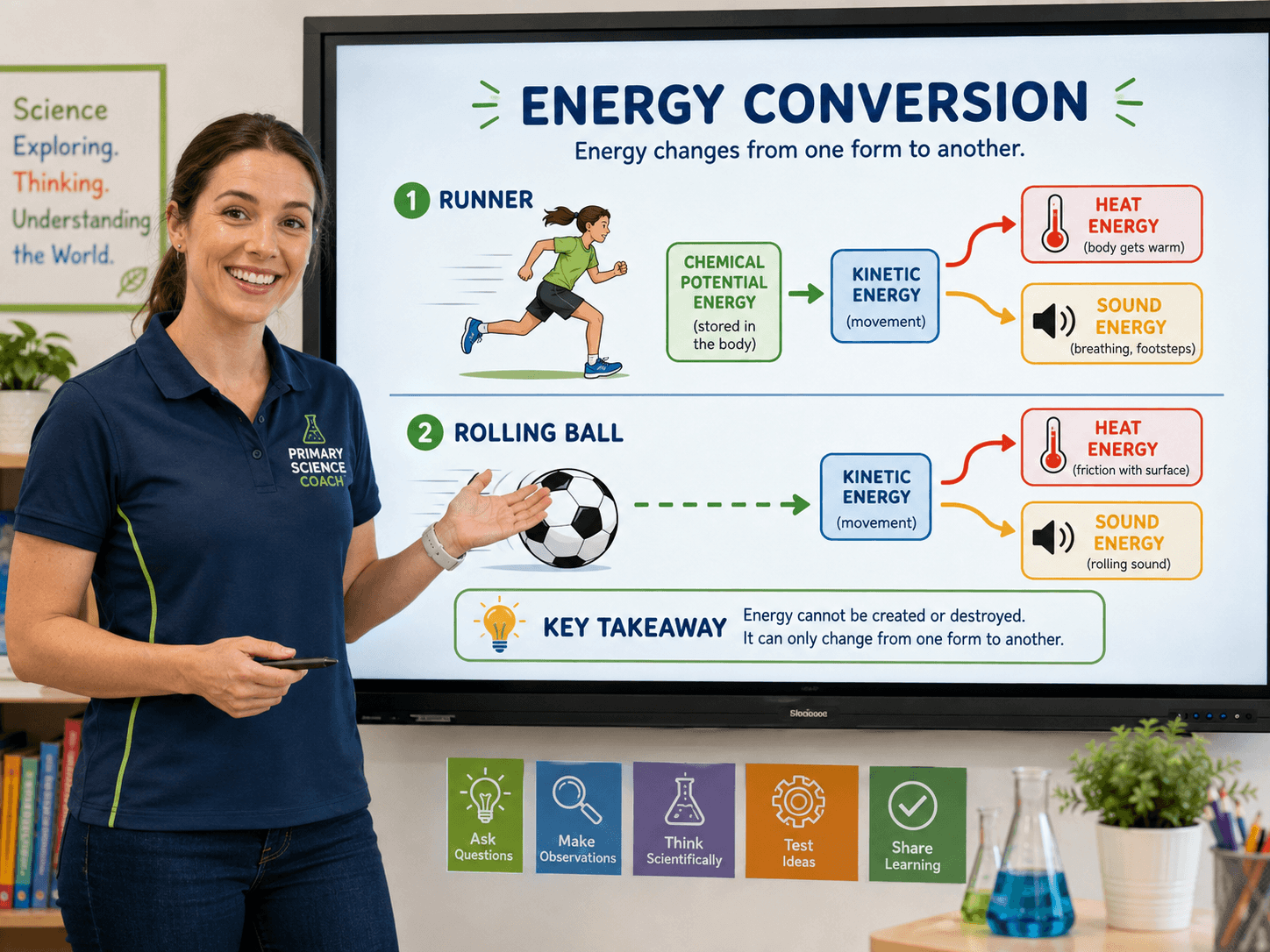
When we move, energy does not simply disappear or get “used up”. Instead, energy is transferred and converted from one form to another. During running, chemical potential energy stored in the body is converted into kinetic energy for movement, while some energy is transferred to the surroundings as heat and sound.
This is an important PSLE Science concept because students need to name the correct forms of energy and describe clearly how the energy changes during an event.
The Question / Scenario Explanation
Source: Ran 2.4 km, burning hot. No fire—so where’s the heat from?
Imagine that you have just finished running 2.4 km. Your legs were moving, your arms were swinging, your footsteps made sounds and your body became warmer.
Several energy changes were taking place at the same time.
The body obtains chemical potential energy from food. During running, this energy is converted and transferred into several forms, including:
- kinetic energy of the moving body;
- heat energy transferred within the body and to the surroundings; and
- sound energy produced by footsteps, breathing and movement.
A useful principle for students to remember is that energy is conserved. It is not created or destroyed during an ordinary energy conversion. Instead, it changes form or is transferred from one object or place to another.
Step-by-Step Solution / Explanation
Step 1: Identify the Starting Form of Energy
Before running, the body has stored chemical potential energy obtained from food.
This stored energy can be released during processes in the body and used to support movement and other activities.
For a PSLE Science explanation, students should avoid simply writing “the body has energy”. It is better to identify the form:
Chemical potential energy in the body.
Step 2: Identify the Energy of Movement
As the runner moves, the body has kinetic energy.
Kinetic energy is the energy an object has because it is moving.
Therefore:
Chemical potential energy in the body is converted into kinetic energy of the moving body.
This is why the runner is able to move their legs, swing their arms and travel forward.
Step 3: Explain Why the Body Becomes Hot
Not all the chemical potential energy results in useful movement.
During activity, some energy is converted and transferred as heat. This contributes to the increase in body temperature and the warmth felt after exercise.
So a more complete energy change is:
Chemical potential energy → kinetic energy + heat energy
This explains why a person can become hot even though there is no fire involved.
Step 4: Identify Sound Energy
Running can also produce sound.
Examples include:
- shoes striking the ground;
- heavy breathing; and
- clothing moving against the body.
Some energy is therefore transferred as sound energy.
A simplified energy conversion can be written as:
Chemical potential energy → kinetic energy + heat energy + sound energy
Step 5: Understand What “Energy Is Conserved” Means
Students sometimes write that energy has been “used up”. This can be misleading.
Energy is conserved. During a process, it may be converted into other forms or transferred to the surroundings.
For example, in a battery-powered device:
Chemical potential energy in the battery → electrical energy → light, heat and/or sound energy
When a battery can no longer operate the device effectively, it does not mean energy has vanished. The battery’s store of chemical energy available for the useful process has decreased as energy has been transferred and converted.
Step 6: Apply the Concept to a Rolling Ball
Now consider the quiz from the video:
A boy kicks a ball. The ball rolls along the ground and eventually stops. Why?
When the boy kicks the ball, energy is transferred from the boy to the ball, giving the ball kinetic energy.
As the ball rolls, friction acts between the ball and the ground. Air resistance can also oppose its motion.
Some of the ball’s kinetic energy is transferred to the surroundings, mainly as heat and a small amount of sound.
As the ball loses kinetic energy, it slows down and eventually stops.
A suitable explanation is:
The kinetic energy of the ball is transferred to the surroundings mainly as heat energy due to friction, with some sound energy produced. The ball therefore slows down and eventually stops.
Step 7: Use the Correct PSLE Science Wording
Instead of writing:
“The energy disappeared.”
or:
“The energy was used up.”
students should write something more precise, such as:
“The kinetic energy of the ball was transferred to the surroundings as heat and sound energy.”
This identifies:
- the form of energy;
- the object associated with the energy; and
- what the energy was converted or transferred into.
Key Concepts Students Must Know
- Chemical potential energy: Energy stored in substances such as food and batteries.
- Kinetic energy: Energy possessed by a moving object.
- Heat energy: Energy that may be transferred because of temperature differences or produced during processes involving friction and biological activity.
- Sound energy: Energy carried by sound waves produced by vibrating objects.
- Energy conversion: Energy changing from one form into another.
- Energy transfer: Energy moving from one object or place to another.
- Conservation of energy: Energy is not created or destroyed; it is converted or transferred.
For PSLE Science, students should state the specific object whenever possible. For example, write “kinetic energy of the ball” instead of simply writing “kinetic energy”.
Exam Tips / Common Mistakes
Exam Tips
- Name the exact form of energy: chemical potential, kinetic, heat, light, sound or electrical energy.
- State which object possesses the energy where relevant.
- Use words such as converted or transferred instead of saying energy simply disappeared.
- Look carefully at what is happening in the diagram: Is something moving, heating up, producing light or making sound?
- For moving objects that slow down, consider friction and energy transfer to the surroundings.
- Follow the entire energy chain when more than one conversion happens.
Common Mistakes
- Saying energy is “used up”: Energy is converted or transferred rather than destroyed.
- Naming only one form: A situation may involve several energy outputs, such as kinetic, heat and sound energy.
- Leaving out the object: “Kinetic energy of the ball” is clearer than simply “kinetic energy”.
- Saying friction destroys energy: Friction causes kinetic energy to be transferred mainly as heat to the objects and surroundings.
- Assuming all energy becomes useful movement: Some energy is usually transferred to other forms, including heat and sound.
Parent Insight
Energy can feel abstract to Primary Science students because they cannot always see it directly. Everyday examples can make the concept easier to understand.
After your child runs, ask, “Why do you feel warmer?” When a toy car stops rolling, ask, “Where did its kinetic energy go?” When a torch is switched on, ask, “What energy conversions are happening?”
Encourage your child to answer using a complete energy chain rather than a single word.
For example:
Battery: chemical potential energy → electrical energy → light and heat energy.
Practising with familiar situations helps students recognise similar patterns when they appear in examination questions.
Conclusion
Energy conversion explains why your body becomes hot after running even though there is no fire.
The chemical potential energy available in the body is converted and transferred into different forms, including kinetic energy for movement, heat energy and sound energy.
The same principle explains why a rolling ball eventually stops. Its kinetic energy is gradually transferred to the surroundings, mainly as heat because of friction, with some energy transferred as sound.
The key PSLE Science takeaway is:
Do not say energy disappears. Name the energy forms and explain how energy is converted or transferred.
Visit our Primary Science homepage: Explore MasterScience
Read more Primary Science guides: Visit Our Science Blog
Start here (limited slots weekly):
Free Trial: Click Here…
Enroll: Click Here…
Explore our main tuition brand approach here: Click Here…