
Introduction
Table-based circuit questions can be tricky because students guess from the diagram instead of matching the results. This electric circuit switches question becomes easy when you focus on one key clue: each time, only 1 bulb lights up.
The Question / Scenario Explanation
Source: P5 Question 2
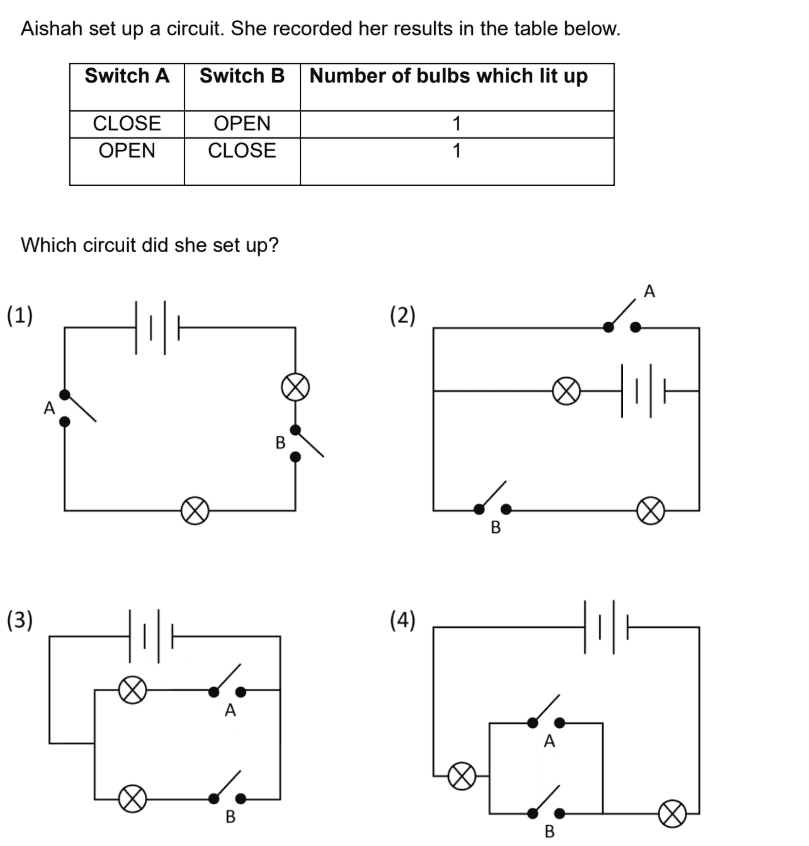
Aishah set up a circuit. She recorded her results:
- Switch A CLOSE, Switch B OPEN → Number of bulbs which lit up: 1
- Switch A OPEN, Switch B CLOSE → Number of bulbs which lit up: 1
Question: Which circuit did she set up?
Options: (1), (2), (3), (4)
Step-by-Step Solution / Explanation
Step 1: Interpret the table correctly
From the table, we know:
- When only A is closed, exactly 1 bulb lights.
- When only B is closed, exactly 1 bulb lights.
This means A and B control different bulbs (each switch turns on its own path).
So the circuit must allow current to flow through one bulb at a time, depending on which switch is closed.
Step 2: What circuit feature should we look for?
We need a circuit where:
- Switch A is in one branch with a bulb
- Switch B is in another branch with a bulb
- Closing A completes only branch A (lights 1 bulb)
- Closing B completes only branch B (lights 1 bulb)
That describes a parallel-type arrangement, where each switch controls its own branch.
Step 3: Match this to the options
- Option (1): Switches are in the same main loop (series). If one switch is open, the circuit is broken → not consistent.
- Option (2): The arrangement does not make each switch control a separate bulb cleanly (may keep circuit incomplete or affect both).
- Option (4): Switches sit in a middle section that affects the same path; it won’t behave like “A alone lights exactly 1 bulb” and “B alone lights exactly 1 bulb” reliably.
- Option (3): Two separate branches, each with its own bulb and its own switch (A controls one, B controls the other). ✅
✅ Final Answer: Option (3)
Key Concepts Students Must Know
- In electric circuit switches questions, the results table tells you whether the circuit behaves like series or parallel.
- If closing either switch lights a bulb, that suggests each switch completes its own path.
- Series circuit: one open switch breaks the whole circuit.
- Parallel branches: one branch can work even if the other is open.
Exam Tips / Common Mistakes
Exam Tips
- Translate the table into simple statements:
- “A alone → 1 bulb”
- “B alone → 1 bulb”
- Then look for a diagram with two separate branches, each controlled by its own switch.
- Count bulbs lit in each condition before choosing the option.
Common Mistakes
- Assuming “more switches means more bulbs light” (not always).
- Not noticing that the table never shows “2 bulbs lit”, so it cannot be a circuit where one switch turns on both bulbs.
- Forgetting: in series circuits, an open switch usually stops all bulbs.
Parent Insight
This type of electric circuit switches question builds reasoning, not just memorisation. Encourage your child to read the table like a story (“A works by itself”, “B works by itself”), then choose the diagram that matches the story. This prevents random guessing.
Conclusion
The table shows that closing switch A alone lights 1 bulb, and closing switch B alone also lights 1 bulb. So each switch must control a separate branch with its own bulb. The only circuit that matches this is Option (3).
Visit our Primary Science homepage: Click Here…
Read more Primary Science practice and explanations here: Click Here…
Start here (limited slots weekly):
Free Trial: Click Here…
Enroll: Click Here…
Explore our main tuition brand approach here: Click Here… .