
Introduction
Many students remember that some objects float while others sink, but they may not always understand why. In PSLE Science, the key concept behind this is density floating sinking.
Density helps us compare how closely packed the matter in an object is, when an object is placed in a liquid, whether it floats or sinks depends on the object’s density compared to the density of the liquid.
Once students understand this comparison, density floating sinking questions become much easier to answer using clear scientific reasoning.
The Question / Scenario Explanation
Source: Coach Akid VT – Script 2 – 15 June 2026
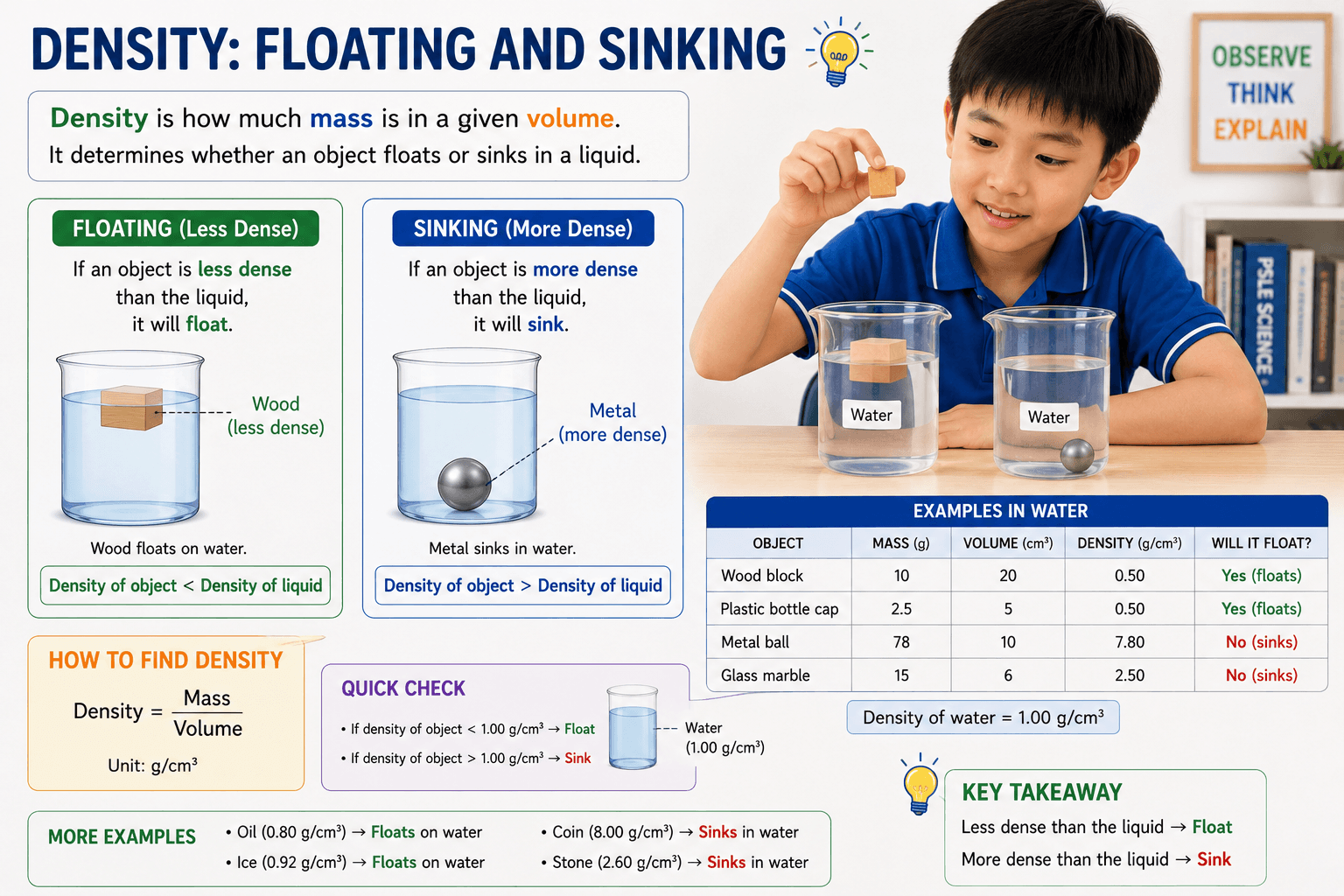
The screenshots explain how density determines whether an object floats or sinks in a liquid.
The main ideas shown are:
- If an object is less dense than the liquid, it floats.
- If an object is denser than the liquid, it sinks.
- Ice floats on water because ice is less dense than water.
This means students should not answer based only on the size, shape, or weight of an object. Instead, they must compare the density of the object with the density of the liquid.
Step-by-Step Solution / Explanation
Step 1: Understand What Density Means
Density tells us how much matter is packed into a certain volume.
In simple words:
- An object with higher density has matter packed more closely together.
- An object with lower density has matter packed less closely together.
For PSLE Science, students usually do not need to calculate complicated density values. They mainly need to compare density and explain whether an object floats or sinks.
Step 2: Compare the Object with the Liquid
To decide whether an object floats or sinks, compare the density of the object with the density of the liquid.
If the object is less dense than the liquid, it floats.
If the object is denser than the liquid, it sinks.
This is the main rule behind density floating sinking questions.
Step 3: When the Object Is Less Dense Than the Liquid
The first screenshot shows an object floating in a liquid. This happens because the object is less dense than the liquid.
A correct scientific explanation would be:
The object floats because it is less dense than the liquid.
Students should avoid vague answers like “it is light”. The better answer must compare the object’s density with the liquid’s density.
Step 4: When the Object Is More Dense Than the Liquid
The second screenshot shows an object sinking in a liquid. This happens because the object is denser than the liquid.
A correct scientific explanation would be:
The object sinks because it is denser than the liquid.
This explanation is clear, direct, and uses the correct Science keyword.
Step 5: Understand Why Ice Floats on Water
The third screenshot shows that ice floats on water. This is because ice is less dense than water.
Even though ice is solid, it can still float because its density is lower than that of water.
A good PSLE Science answer would be:
Ice floats on water because ice is less dense than water.
Step 6: Do Not Judge by Size Alone
One common mistake is thinking that big objects always sink and small objects always float. This is not always true.
For example:
- A large wooden log may float because wood is less dense than water.
- A small metal coin may sink because metal is denser than water.
This is why students must focus on density, not just size or weight.
Step 7: Use the Correct Science Sentence
For exam answers, students can use these sentence structures:
- The object floats because it is less dense than the liquid.
- The object sinks because it is denser than the liquid.
- Ice floats on water because ice is less dense than water.
These sentence structures help students answer density floating sinking questions clearly and accurately.
Key Concepts Students Must Know
- Density is about how closely matter is packed: More closely packed matter means higher density.
- Floating depends on comparison: An object floats if it is less dense than the liquid.
- Sinking depends on comparison: An object sinks if it is denser than the liquid.
- Ice floats on water: Ice is less dense than water, so it floats.
- Size alone is not enough: A large object can float, and a small object can sink depending on density.
Exam Tips / Common Mistakes
Exam Tips
- Always compare the density of the object with the density of the liquid.
- Use the words “less dense than” or “more dense than” in your explanation.
- Do not just say an object floats because it is “light”.
- Check whether the question is asking about the object, the liquid, or both.
- For ice and water questions, remember that ice is less dense than water.
Common Mistakes
- Writing that big objects always sink.
- Writing that small objects always float.
- Forgetting to compare the object with the liquid.
- Using weight instead of density as the main explanation.
- Saying ice floats because it is cold instead of because it is less dense than water.
A common exam trap is when students focus only on whether an object looks heavy or light. In Science, the better explanation must use density comparison. This is the key to answering density floating sinking questions properly.
Parent Insight
Children often understand Science better when they can test ideas in real life. Parents can support this topic using simple household objects and a bowl of water.
For example, your child can observe whether different objects float or sink, such as:
- a plastic bottle cap
- a coin
- an ice cube
- a small piece of wood
- a metal spoon
After observing, ask your child to explain using Science keywords:
- “Is the object more dense or less dense than water?”
- “Why did it float?”
- “Why did it sink?”
- “Can a large object float? Why?”
This helps students move beyond memorising and start applying the concept to real situations.
Conclusion
Density floating sinking questions become easier when students remember one main rule: compare the density of the object with the density of the liquid.
If the object is less dense than the liquid, it floats. If the object is denser than the liquid, it sinks. Ice floats on water because ice is less dense than water.
With the correct Science keywords and clear comparison, students can answer PSLE Science questions on floating and sinking with much more confidence.
Visit our homepage: Click Here…
Read more on our blog: Click Here…
Start here (limited slots weekly):
Free Trial: Click Here…
Enroll: Click Here…
Explore our main tuition brand approach here: Click Here… .