
Introduction
Many students are surprised when they look at a spoon and notice something strange. On one side, their image appears upside down. On the other side, their image appears upright. How can the same spoon create two different images?
This is where concave convex reflection becomes important. In PSLE Science, students learn that light reflects off surfaces and enters our eyes, allowing us to see images. However, the shape of the reflecting surface affects how the image appears.
In this guide, we will explain concave convex reflection using a simple everyday object — a spoon. Once students understand how the inside and outside of the spoon reflect light differently, this topic becomes much easier to remember.
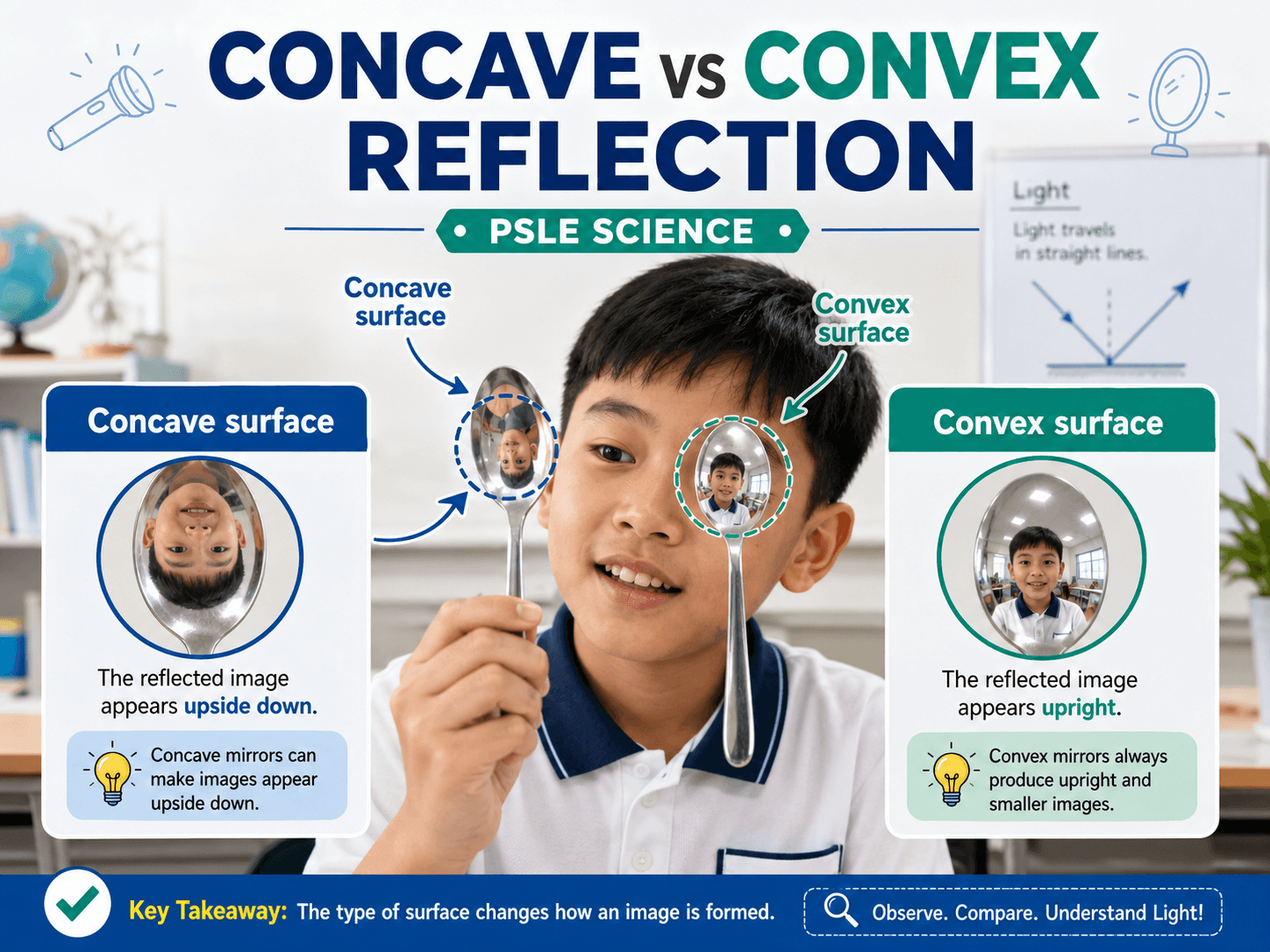
The Question / Scenario Explanation
Source: Grab a spoon. Back = upright. Inside = upside down. Same spoon, why?
The screenshots show a teacher explaining why the inside of a spoon makes your image appear upside down, while the back of the spoon makes your image appear upright.
The main ideas explained are:
- Light reflects off surfaces and enters our eyes.
- A flat mirror reflects light evenly, so the image looks normal in size and orientation.
- The inside of a spoon curves inwards. This is a concave surface.
- The back of a spoon curves outwards. This is a convex surface.
- Because the two surfaces curve differently, the reflected light rays behave differently, so the image looks different.
When looking at the inside of the spoon, the reflected rays cross over, causing the image to flip and appear upside down. When looking at the back of the spoon, the rays spread out, so the image stays upright.
Step-by-Step Solution / Explanation
Step 1: Understand How We See Images
We see objects because light reflects off them and enters our eyes. Our brain then interprets the light and forms an image.
For example, when you look into a mirror, light bounces off your face, reflects off the mirror, and enters your eyes. This is why you can see yourself.
In the case of a spoon, the same thing happens. The difference is that the spoon is not flat like a mirror. Its curved surfaces change the way light reflects.
Step 2: Know What a Concave Surface Is
The inside of a spoon curves inwards, like the inside of a bowl. This curved-in surface is called a concave surface.
In concave convex reflection, a concave surface causes light rays to bounce inwards. When the reflected rays cross over one another, the image appears inverted, which means upside down.
This is why your face looks upside down when you look at the inside of the spoon.
Step 3: Understand Why the Image Flips
The video explains that the rays from the top of the object can be reflected toward the bottom, while the rays from the bottom can be reflected toward the top. As the rays cross, the image is flipped.
So when students ask why the image is upside down, the Science reason is:
The inside of the spoon is concave, causing light rays to cross over and form an upside-down image.
Step 4: Know What a Convex Surface Is
The back of the spoon curves outwards. This curved-out surface is called a convex surface.
In concave convex reflection, a convex surface causes reflected light rays to spread apart. Because of this, the image appears upright.
When you look at the back of the spoon, your image does not flip upside down. Instead, it remains upright, though it may appear smaller.
Step 5: Compare the Two Spoon Surfaces
The spoon is useful because it shows both types of curved surfaces in one object:
- Inside of the spoon: concave, curves inwards, image appears upside down.
- Back of the spoon: convex, curves outwards, image appears upright.
This comparison helps students understand why the same spoon can produce two different image effects.
Step 6: Relate It to Reflection
This topic is still about reflection. Light is bouncing off the spoon just like it bounces off a mirror. However, because the spoon is curved, the reflection changes.
A flat mirror gives a regular reflection, while a curved surface gives a different reflection pattern. That is why concave convex reflection is an important idea in Science.
Step 7: Try the Spoon Test Yourself
Students can easily test this at home.
- Take a spoon.
- Look at your reflection on the inside of the spoon.
- Notice that your image appears upside down.
- Then turn the spoon around and look at the back.
- Notice that your image appears upright.
This simple activity helps students remember the difference more clearly than memorising definitions alone.
Key Concepts Students Must Know
- Light reflection allows us to see images: Light reflects off surfaces and enters our eyes.
- Concave means curved inwards: The inside of a spoon is concave.
- Convex means curved outwards: The back of a spoon is convex.
- Concave surfaces can produce upside-down images: This happens because the reflected light rays cross over.
- Convex surfaces produce upright images: The reflected light rays spread apart.
Exam Tips / Common Mistakes
Exam Tips
- Always identify whether the surface is curved inwards or outwards.
- Use the correct Science terms: concave and convex.
- When explaining the upside-down image, mention that the light rays cross over.
- When explaining the upright image, mention that the rays spread apart.
- Use examples from daily life, such as a spoon, to remember the concept.
Common Mistakes
- Mixing up concave and convex surfaces.
- Saying the spoon produces light instead of reflecting light.
- Thinking the spoon works differently from reflection.
- Forgetting that the inside of the spoon curves inwards.
- Writing vague answers such as “the spoon changes the image” without explaining how.
A strong exam answer should explain the shape of the surface and how the light rays behave. For example, students should not simply write “the image is upside down because of the spoon”. They should explain that the inside of the spoon is concave, causing the reflected rays to cross over.
Parent Insight
Parents can make this topic more meaningful by turning it into a quick home experiment. Ask your child to take a spoon and observe both sides carefully. Then ask questions such as:
- Which side curves inwards?
- Which side curves outwards?
- On which side does the image look upside down?
- On which side does the image look upright?
This helps children connect Science ideas to real life. Instead of memorising definitions, they can observe the effect directly and explain it in their own words. This is especially helpful for building confidence in open-ended Science questions.
Conclusion
Concave convex reflection becomes much easier when students use a spoon as an example. The inside of the spoon is concave, so light rays cross over and the image appears upside down. The back of the spoon is convex, so light rays spread apart and the image appears upright.
Although both sides reflect light, the different shapes cause the images to look different. By remembering “inside = concave = upside down” and “back = convex = upright”, students can answer this type of PSLE Science question more confidently.
Visit our homepage: Click Here…
Read more on our blog: Click Here…
Start here (limited slots weekly):
Free Trial: Click Here…
Enroll: Click Here…
Explore our main tuition brand approach here: Click Here… .