
Introduction
Series and parallel circuits are a common Science topic that many Primary and PSLE students find confusing at first. A very common real-life question is this: if one bulb burns out, why do some lights all go off, while others keep shining?
The answer depends on whether the bulbs are arranged in a series circuit or a parallel circuit. Once students understand how electric current flows through each type of circuit, this topic becomes much easier to remember.
In this article, we will use the Christmas lights and house lights example to explain the difference clearly. This is a useful concept for answering multiple-choice questions, open-ended questions, and diagram-based questions in PSLE Science.
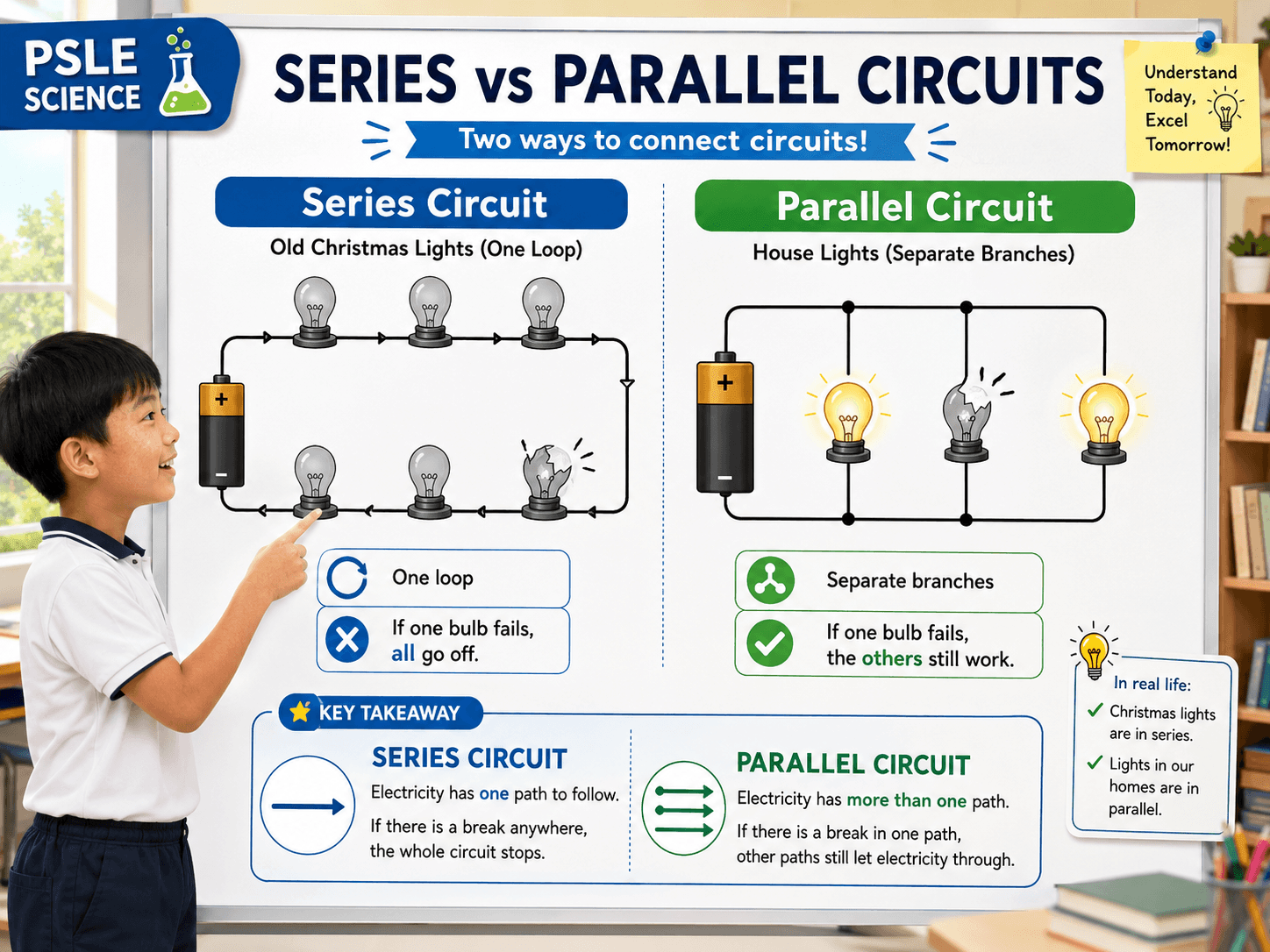
The Question / Scenario Explanation
Source: One bulb burns out — why don’t all your lights go with it?
The screenshots compare two situations:
- Old Christmas lights connected in one loop
- House lights connected in separate paths
In the first case, when one bulb stops working, the whole circuit is broken and all the bulbs go off. In the second case, if one bulb burns out, the other bulbs can still stay on because they each have their own path.
This is exactly the difference between series and parallel circuits.
Step-by-Step Solution / Explanation
Step 1: Understand What a Circuit Is
A circuit is a complete path that allows electric current to flow from the power source, through the components, and back to the power source.
For bulbs to light up, the circuit must be complete. If the path is broken, electric current cannot flow and the bulb will not light up.
Step 2: What Is a Series Circuit?
In a series circuit, all the bulbs or components are connected in one single loop.
This means:
- There is only one path for the current to flow.
- The current must pass through each bulb one after another.
- If one bulb is removed or spoilt, the path is broken.
When the path is broken, current cannot continue flowing through the circuit. As a result, all the bulbs go off.
This is why old Christmas lights often stopped working completely when one bulb failed.
Step 3: What Is a Parallel Circuit?
In a parallel circuit, the bulbs are connected in separate branches.
This means:
- There is more than one path for the current to flow.
- Each bulb has its own path back to the power source.
- If one bulb is removed or spoilt, only that branch is broken.
The other branches remain complete, so current can still flow through them. Therefore, the other bulbs stay on.
This is why most house lights are connected using a parallel circuit.
Step 4: Apply This to the Question
The question asks why one bulb burning out does not always turn off all the other lights.
The explanation is:
- If the bulbs are in a series circuit, one failed bulb breaks the only path, so all the bulbs go off.
- If the bulbs are in a parallel circuit, one failed bulb only breaks one branch, so the other bulbs stay on.
So if two bulbs remain on after one bulb burns out, the circuit must be a parallel circuit.
Step 5: Use Science Keywords Clearly
In PSLE Science, it is important to explain using proper keywords. Instead of saying “the electricity cannot move”, students should write more accurately:
- Series circuit: The circuit is broken, so electric current cannot flow through the complete circuit.
- Parallel circuit: One branch is broken, but the other branches remain complete, so electric current can still flow through them.
These exact science ideas help students score better in open-ended explanations.
Step 6: Link the Concept to Real Life
This topic is not just for exams. It explains everyday things around us.
- Old decorative lights: often behave like a series circuit, where one failed bulb affects the whole set.
- House lighting: behaves like a parallel circuit, so one spoilt bulb usually does not cause the whole house to go dark.
This real-life link helps students remember the difference more easily.
Key Concepts Students Must Know
- Series circuit: one loop, one path for current.
- Parallel circuit: separate branches, more than one path for current.
- Complete circuit: current can flow.
- Broken circuit: current cannot flow.
- In a series circuit, if one bulb fails, all bulbs go off.
- In a parallel circuit, if one bulb fails, the other bulbs can still stay on.
Exam Tips / Common Mistakes
Exam Tips
- Look carefully at whether the diagram shows one path or multiple branches.
- If only one bulb goes off while others stay on, think parallel circuit.
- If one failed bulb causes all the others to go off, think series circuit.
- Use keywords such as complete circuit, broken circuit, electric current, and branch.
- Always explain why the current can or cannot continue flowing.
Common Mistakes
- Saying a bulb lights up “because electricity is inside it” without explaining the circuit path.
- Mixing up series and parallel circuits.
- Forgetting that a broken circuit stops current flow.
- Writing vague answers like “the other bulbs are stronger”.
- Not using proper scientific reasoning in open-ended answers.
Exam trap: some questions test whether students can identify the circuit type from what happens when one bulb is removed. Always focus on what happens to the path of current, not just what happens to the bulbs.
Parent Insight
Many students memorise that “series means all go off” and “parallel means others stay on”, but they do not always understand why. This makes them more likely to get diagram questions wrong.
Parents can help by asking simple guiding questions such as:
- How many paths are there for the current?
- What happens if one path is broken?
- Can current still flow through the other branches?
When students can explain the reasoning in their own words, they usually remember the concept better and perform more confidently in Science exams.
Conclusion
Series and parallel circuits become much easier once students focus on the number of paths available for electric current.
- In a series circuit, there is only one path, so one failed bulb breaks the whole circuit and all the bulbs go off.
- In a parallel circuit, there are multiple paths, so if one bulb fails, the other bulbs can still stay on.
This is why old Christmas lights may all go dark together, but house lights usually keep working even if one bulb burns out. Understanding this clearly can help students answer both concept and application questions more accurately.
Visit our homepage: Click Here…
Read more on our blog: Click Here…
Start here (limited slots weekly):
Free Trial: Click Here…
Enroll: Click Here…
Explore our main tuition brand approach here: Click Here…