
Introduction
Many students think mass and weight are the same thing, but in Science, they are different. This is why mass vs weight questions can confuse students every year, especially when the question involves Earth, the Moon, or outer space.
In PSLE Science, students must understand that mass is the amount of matter in an object, while weight is the force of gravity acting on that object. This means your mass stays the same wherever you go, but your weight can change depending on gravity.
Once students understand this difference, mass vs weight questions become much easier to answer clearly and accurately.
The Question / Scenario Explanation
Source: Mass vs Weight – are they really the same thing?
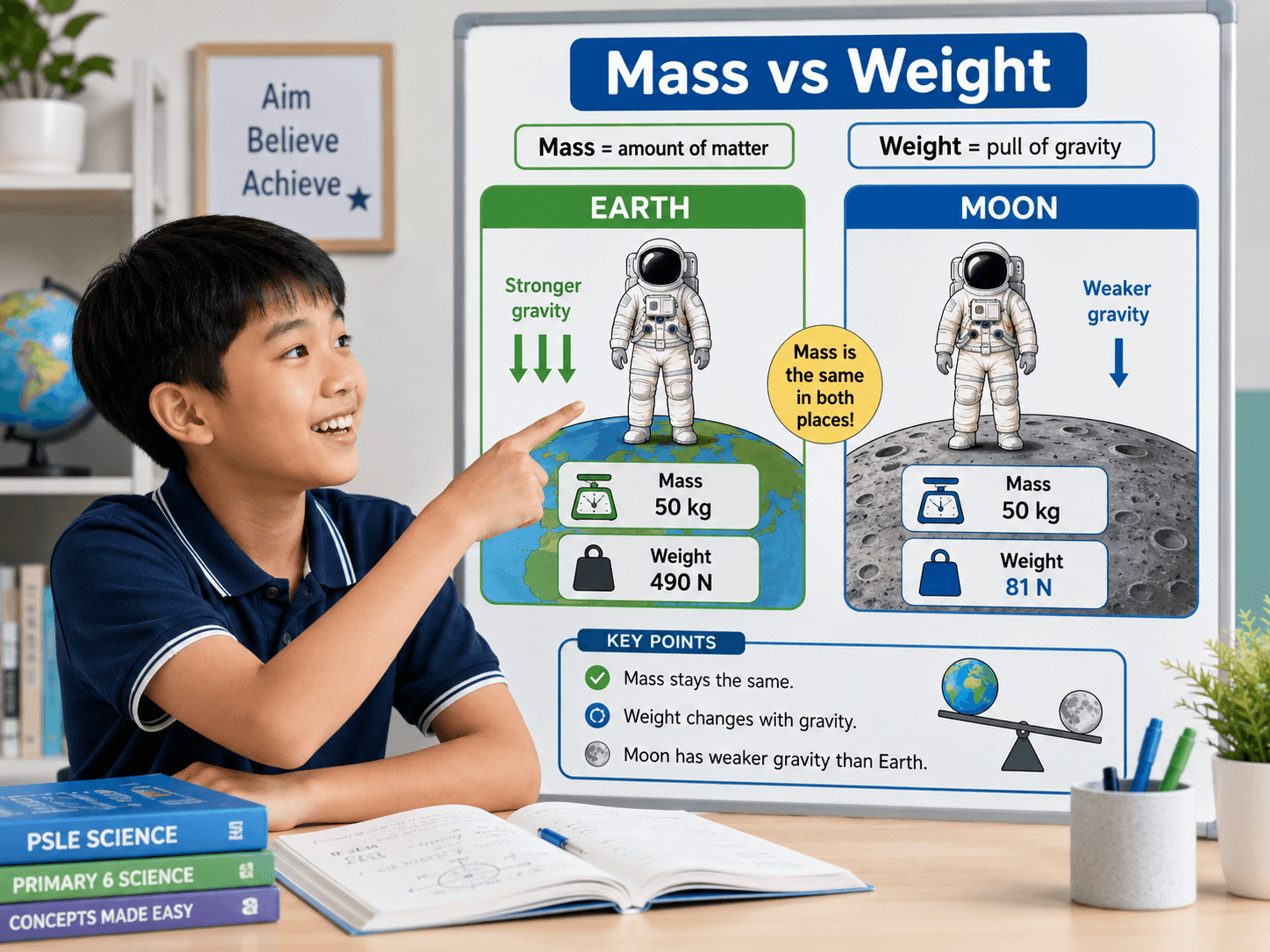
The screenshots explain an important Science idea: if a person goes to the Moon, Mars, or floats in space, their mass does not change. However, their weight can change because gravity is different in different places.
The video highlights that the Moon has weaker gravity than Earth, about six times weaker. This means a person would weigh less on the Moon because the Moon pulls them down with less force.
The quiz question shown is:
An astronaut has a mass of \(60\text{ kg}\) on Earth. What is his mass on the Moon?
The correct answer is:
\(60\text{ kg}\)
This is because mass does not change when the astronaut goes to the Moon.
Step-by-Step Solution / Explanation
Step 1: Understand What Mass Means
Mass is the amount of matter in an object.
For example, if an astronaut has a mass of \(60\text{ kg}\), it means the astronaut contains that amount of matter. This amount of matter does not change just because the astronaut moves from Earth to the Moon.
Mass is measured in kilograms, written as \( \text{kg} \).
Step 2: Understand What Weight Means
Weight is the force of gravity acting on an object.
This means weight depends on how strongly gravity pulls the object down. If gravity is stronger, the object weighs more. If gravity is weaker, the object weighs less.
Weight is a force, so it is measured in newtons, written as \( \text{N} \).
Step 3: Compare Gravity on Earth and the Moon
Earth has stronger gravity than the Moon. The Moon’s gravity is weaker, about one-sixth of Earth’s gravity.
This means if a person stands on the Moon, the Moon pulls the person down with less force. As a result, the person’s weight is less on the Moon.
However, the person’s mass stays the same because the amount of matter in the person has not changed.
Step 4: Answer the Astronaut Question
The question says:
An astronaut has a mass of \(60\text{ kg}\) on Earth. What is his mass on the Moon?
Since the question asks for mass, not weight, the answer stays the same.
Mass on the Moon = \(60\text{ kg}\)
The astronaut’s mass does not become smaller just because gravity is weaker on the Moon.
Step 5: Understand What Would Change
If the question asked about the astronaut’s weight, then the answer would change because weight depends on gravity.
On the Moon, the astronaut would weigh less than on Earth because the Moon has weaker gravity. But the astronaut would still have the same mass of \(60\text{ kg}\).
Step 6: Remember the Key Difference
A simple way to remember the difference is:
- Mass stays the same wherever the object goes.
- Weight changes when gravity changes.
This is the most important idea in mass vs weight questions.
Key Concepts Students Must Know
- Mass is the amount of matter: It does not change when an object moves to another planet or the Moon.
- Mass is measured in kilograms: The unit for mass is \( \text{kg} \).
- Weight is a force: It is the force of gravity acting on an object.
- Weight is measured in newtons: The unit for weight is \( \text{N} \).
- Gravity affects weight: Weaker gravity means smaller weight, while stronger gravity means greater weight.
- The Moon has weaker gravity than Earth: So an object weighs less on the Moon, but its mass stays the same.
Exam Tips / Common Mistakes
Exam Tips
- Check whether the question asks for mass or weight.
- If the question asks for mass, remember that it stays the same.
- If the question asks for weight, think about the strength of gravity.
- Use the correct units: \( \text{kg} \) for mass and \( \text{N} \) for weight.
- When explaining, use the phrase “weight changes because gravity changes”.
Common Mistakes
- Writing that mass changes on the Moon.
- Confusing kilograms with newtons.
- Thinking that a person has less matter on the Moon.
- Saying “mass is lighter” instead of explaining weight correctly.
- Forgetting that weight is a force caused by gravity.
A common exam trap is when students see “Moon” and immediately think the answer must become smaller. But for mass vs weight, students must slow down and check whether the question asks for mass or weight.
Parent Insight
Parents can help children understand this concept using simple everyday explanations. For example, ask your child to imagine carrying a school bag on Earth and then carrying the same bag on the Moon.
The bag would contain the same books, so its mass would stay the same. However, it would feel lighter on the Moon because the Moon pulls it down with less gravitational force.
You can ask your child:
- “Does the amount of matter in the astronaut change on the Moon?”
- “Why does the astronaut feel lighter on the Moon?”
- “Which unit is used for mass?”
- “Which unit is used for weight?”
These questions help children build stronger Science reasoning instead of memorising the answer blindly.
Conclusion
Mass vs weight becomes simple when students remember that mass and weight are not the same thing. Mass is the amount of matter in an object, while weight is the force of gravity acting on it.
An astronaut with a mass of \(60\text{ kg}\) on Earth still has a mass of \(60\text{ kg}\) on the Moon. His weight would be less on the Moon because the Moon has weaker gravity, but his mass remains unchanged.
By checking the keyword in the question and using the correct units, students can avoid this common PSLE Science mistake.
Visit our homepage: Click Here…
Read more on our blog: Click Here…
Start here (limited slots weekly):
Free Trial: Click Here…
Enroll: Click Here…
Explore our main tuition brand approach here: Click Here… .