
Introduction
Many students know that blood moves around the body, but they may not realise how active this process is. Blood circulation happens all the time, even when we are sitting, sleeping, studying, or exercising.
In PSLE Science, students need to understand how blood carries oxygen and useful substances around the body. The video explains an interesting idea: by the end of the day, blood may travel a very long distance inside the body as it keeps moving through blood vessels.
This makes blood circulation an important topic because it links the heart, lungs, blood vessels, oxygen, and body cells together.
The Question / Scenario Explanation
Source: Your Blood Travels 100,000 km?
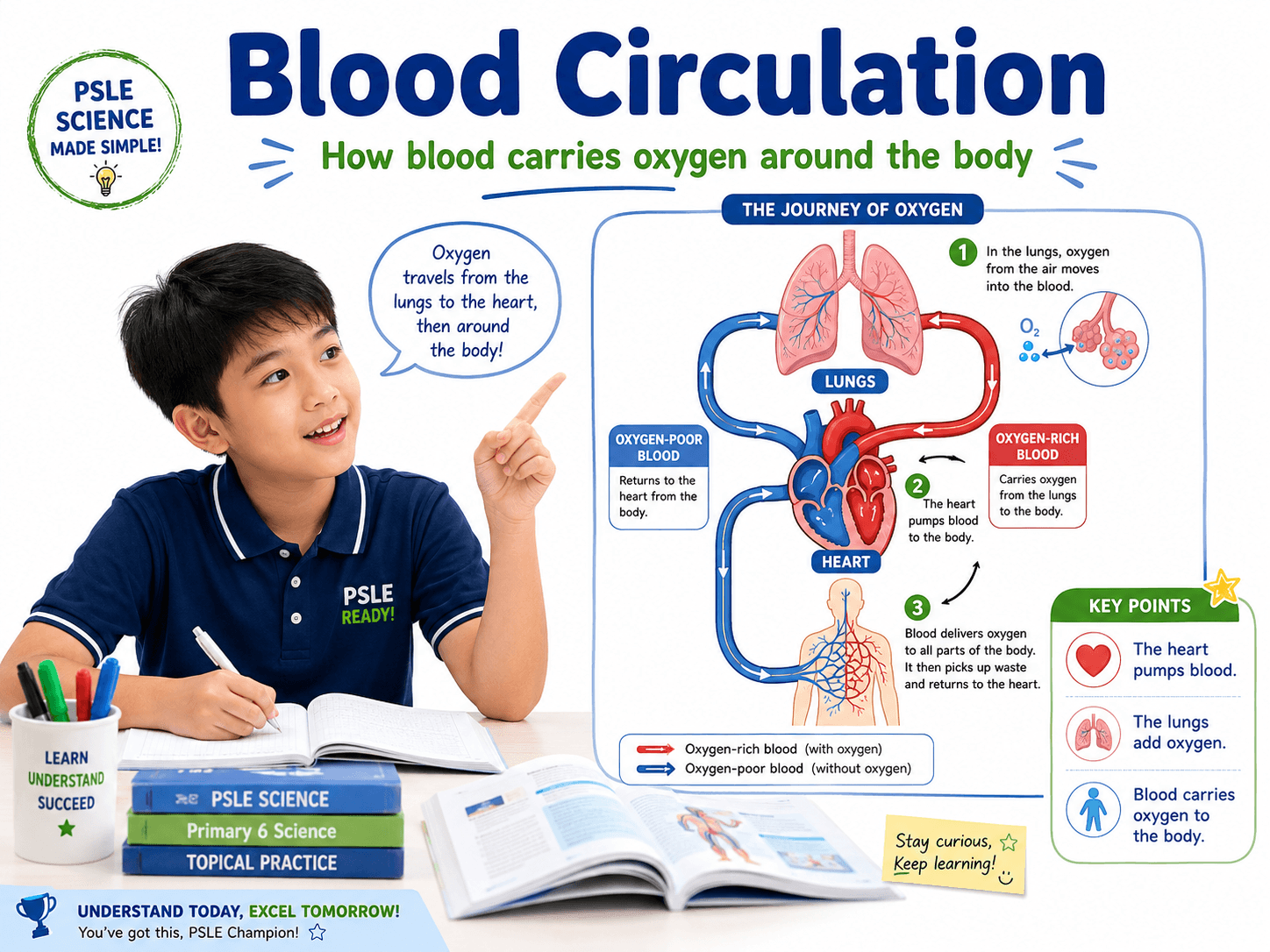
The screenshots show a Science explanation about how blood travels through the body. One part of the video mentions that blood can cover a very long distance in a day. Another part explains that blood first travels to the lungs, where it picks up oxygen.
This helps students understand that blood is not just a red liquid inside the body. It has an important job: transporting oxygen and other materials to different parts of the body.
In a simple PSLE Science explanation:
- The heart pumps blood around the body.
- Blood travels through blood vessels.
- Blood goes to the lungs to pick up oxygen.
- Oxygen-rich blood is carried to the rest of the body.
- Body cells use oxygen to release energy from food.
Step-by-Step Solution / Explanation
Step 1: Understand the Role of the Heart
The heart is a muscular organ that pumps blood throughout the body. It works continuously to keep blood moving.
Without the heart pumping, blood would not be able to carry oxygen and useful substances to the different parts of the body. This is why the heart is a key organ in blood circulation.
Step 2: Blood Travels Through Blood Vessels
Blood does not move randomly inside the body. It travels through tubes called blood vessels.
There are three main types of blood vessels students should know:
- Arteries: Carry blood away from the heart.
- Veins: Carry blood back to the heart.
- Capillaries: Tiny blood vessels where substances are exchanged between blood and body cells.
These blood vessels form pathways that allow blood to reach different parts of the body.
Step 3: Blood Goes to the Lungs to Pick Up Oxygen
The video explains that blood travels to the lungs first. In the lungs, the blood picks up oxygen from the air we breathe in.
This is an important Science concept. Oxygen enters the lungs when we inhale. Then, oxygen passes into the blood through tiny blood vessels around the air sacs in the lungs.
Once the blood has picked up oxygen, it becomes oxygen-rich blood.
Step 4: Oxygen-Rich Blood Travels Around the Body
After picking up oxygen in the lungs, the blood returns to the heart. The heart then pumps this oxygen-rich blood to the rest of the body.
Different body parts need oxygen, including:
- the brain
- the muscles
- the digestive system
- the skin
- other organs and body cells
This is why blood circulation is so important. It helps every part of the body receive what it needs to function properly.
Step 5: Body Cells Use Oxygen to Release Energy
Body cells need oxygen to release energy from food. This energy allows the body to move, grow, repair itself, and carry out life processes.
For example, when a student runs, the muscles need more oxygen. The heart pumps faster so more oxygen-rich blood can reach the muscles.
Step 6: Blood Carries Carbon Dioxide Away
After body cells use oxygen, carbon dioxide is produced as a waste gas. Blood helps carry carbon dioxide away from the body cells and back to the lungs.
When we breathe out, carbon dioxide leaves the body. This shows how the circulatory system and respiratory system work together.
Step 7: Connect the Idea to Daily Life
Students can observe the effects of blood circulation in daily life. When they exercise, their heart beats faster and breathing becomes quicker. This happens because the body needs more oxygen and must remove carbon dioxide faster.
This real-life connection helps students understand that blood circulation is not just a textbook concept. It is happening inside them every moment.
Key Concepts Students Must Know
- The heart pumps blood: The heart keeps blood moving around the body.
- Blood travels through blood vessels: Arteries, veins, and capillaries help transport blood.
- Blood picks up oxygen in the lungs: Oxygen from inhaled air enters the blood in the lungs.
- Blood carries oxygen to body cells: Body cells need oxygen to release energy from food.
- Blood carries carbon dioxide away: Carbon dioxide is transported back to the lungs and breathed out.
- Body systems work together: The circulatory system and respiratory system work closely to keep the body alive.
Exam Tips / Common Mistakes
Exam Tips
- Use correct Science keywords such as “oxygen”, “carbon dioxide”, “blood vessels”, “heart”, and “lungs”.
- Remember that the heart pumps blood, while the lungs help blood pick up oxygen.
- When explaining exercise, mention that muscles need more oxygen to release more energy.
- If the question asks about transport, explain what blood carries and where it carries it to.
- For open-ended questions, write clearly using cause-and-effect sentences.
Common Mistakes
- Writing that the lungs pump blood instead of the heart.
- Forgetting to mention oxygen when explaining the role of blood.
- Thinking that blood only carries oxygen and not carbon dioxide.
- Confusing breathing with blood circulation.
- Giving vague answers such as “blood gives energy” instead of saying blood carries oxygen to cells so they can release energy from food.
A common exam trap is when students say that oxygen gives the body energy directly. A better Science answer is: oxygen helps body cells release energy from food. This wording is clearer and more accurate for PSLE Science.
Parent Insight
Children often remember Science better when concepts are linked to their own body. Parents can help by asking simple daily-life questions such as:
- “Why does your heart beat faster after running?”
- “Why do you breathe faster during exercise?”
- “What does your blood carry to your muscles?”
- “Where does blood pick up oxygen?”
These questions help children connect blood circulation to real experiences. Instead of memorising isolated facts, they begin to understand how the heart, lungs, and blood work together.
Conclusion
Blood circulation is one of the most important processes in the human body. The heart pumps blood, blood travels through blood vessels, and the lungs help blood pick up oxygen.
Oxygen-rich blood is then carried to body cells, where oxygen helps release energy from food. At the same time, blood carries carbon dioxide away so it can be breathed out.
When students understand this process clearly, they can answer PSLE Science questions on the human body with greater confidence.
Visit our homepage: Click Here…
Read more on our blog: Click Here…
Start here (limited slots weekly):
Free Trial: Click Here…
Enroll: Click Here…
Explore our main tuition brand approach here: Click Here… .