
Introduction
Many students find energy topics confusing at first, especially when they see terms like gravitational potential energy and kinetic energy. However, once the idea is broken down simply, it becomes much easier to understand.
In PSLE Science, students need to know that energy can be stored and transferred. One important example is gravitational potential energy, which depends on the height of an object above the ground. The higher the object is, the more stored energy it has.
This concept appears often in Science questions involving roller coasters, playground slides, falling objects, and everyday situations. Let us look at how to understand it clearly.
The Question / Scenario Explanation
Source: Gravitational potential energy doesn’t have to feel so tricky
The video explains two key ideas:
- The greater the height of an object above the ground, the greater its gravitational potential energy.
- When an object moves downwards, stored gravitational potential energy can be converted into kinetic energy.
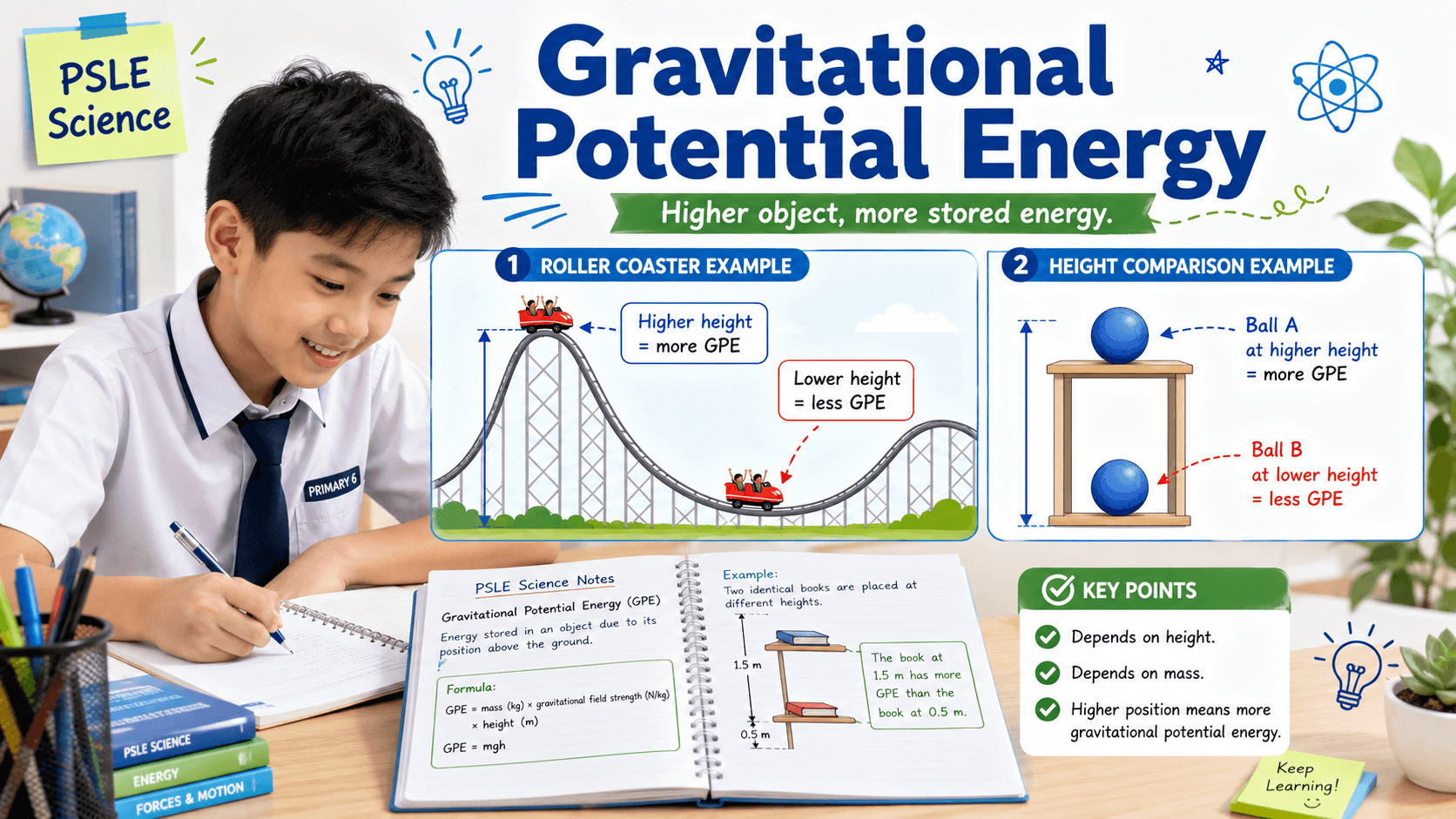
One diagram shows a comparison between kinetic energy and gravitational potential energy. Another screenshot highlights the rule: more height = more GPE. This helps students connect the Science concept to real-life movement.
For example, at the top of a roller coaster track, the car has more gravitational potential energy. As it moves downwards, some of this stored energy changes into kinetic energy, so the car moves faster.
Step-by-Step Solution / Explanation
Step 1: Understand What Gravitational Potential Energy Means
Gravitational potential energy is the stored energy an object has because of its position above the ground.
If an object is lifted higher, it stores more energy. This is because gravity can pull it down over a greater distance.
In simple terms:
- Higher object = more gravitational potential energy
- Lower object = less gravitational potential energy
Step 2: Connect Height to Stored Energy
The main factor highlighted in the video is height. When the height of an object increases, its gravitational potential energy also increases.
For example:
- A book placed on the floor has less gravitational potential energy.
- The same book placed on a high shelf has more gravitational potential energy.
This is why the statement more height = more GPE is so important for PSLE Science students to remember.
Step 3: Understand Energy Conversion
Stored energy does not always stay in the same form. When an object starts moving downwards, gravitational potential energy can be converted into kinetic energy.
Kinetic energy is the energy of movement.
For example:
- At the top of a slide, a child has more gravitational potential energy.
- As the child slides down, that stored energy changes into kinetic energy.
- At the bottom, the child has less gravitational potential energy but more kinetic energy while moving.
Step 4: Use a Roller Coaster Example
The roller coaster picture is a very useful visual example.
At the highest point of the roller coaster:
- The car has a lot of gravitational potential energy.
- Its kinetic energy is lower if it is moving slowly.
As the roller coaster goes down:
- Its gravitational potential energy decreases.
- Its kinetic energy increases.
This shows that energy is converted from one form to another.
Step 5: Apply It to Daily Life
This concept is not only for roller coasters. Students can observe it in daily life too.
- A ball held high up has more gravitational potential energy.
- A diver standing on a high diving board has more gravitational potential energy.
- A flowerpot on a balcony has more gravitational potential energy than one on the ground.
These examples help students remember that gravitational potential energy depends on height above the ground.
Step 6: Focus on the Science Keywords
When answering Science questions, students should use accurate keywords such as:
- stored energy
- height above the ground
- converted
- kinetic energy
- movement
Using the correct keywords helps students explain the concept more clearly in open-ended questions.
Key Concepts Students Must Know
- Gravitational potential energy is stored energy: It is stored because of an object’s position above the ground.
- Height matters: The higher the object is, the more gravitational potential energy it has.
- Energy can be converted: Gravitational potential energy can change into kinetic energy when an object moves downwards.
- Kinetic energy is movement energy: When something moves faster, it usually has more kinetic energy.
- Science answers need keywords: Students should explain using proper Science terms, not just casual descriptions.
Exam Tips / Common Mistakes
Exam Tips
- Always look for clues about height when the question mentions gravitational potential energy.
- Remember the phrase: greater height above the ground = more gravitational potential energy.
- If an object is falling or moving downwards, think about energy conversion into kinetic energy.
- Use Science keywords like “stored energy”, “converted”, and “movement”.
- Study diagrams carefully, especially if they compare different heights or energy levels.
Common Mistakes
- Thinking that heavier always means more gravitational potential energy without noticing the role of height.
- Confusing gravitational potential energy with kinetic energy.
- Forgetting that kinetic energy is the energy of movement.
- Saying energy disappears instead of saying it is converted from one form to another.
- Writing short answers without using proper Science terms.
A common exam trap is when students see an object moving fast and forget to explain how its energy changed. If the object came down from a height, the answer should mention that gravitational potential energy was converted to kinetic energy.
Parent Insight
For many children, Science becomes easier when abstract ideas are linked to everyday examples. Parents can help by asking simple questions like:
- “Which has more gravitational potential energy: a toy on the floor or on a table?”
- “What happens to the energy when a ball drops from your hand?”
- “Why does a roller coaster speed up when it goes down?”
These short conversations help children connect classroom learning to real life. Once the concept becomes visual and relatable, students are more likely to remember it during exams.
Conclusion
Gravitational potential energy becomes much easier when students remember one key idea: the greater the height above the ground, the greater the stored energy.
As an object moves downwards, this stored energy can be converted into kinetic energy. Whether it is a roller coaster, a ball, or a child on a slide, the same Science concept applies.
With clear understanding and regular practice, students can answer PSLE Science questions on energy with much more confidence.
Visit our homepage: Click Here…
Read more on our blog: Click Here…
Start here (limited slots weekly):
Free Trial: Click Here…
Enroll: Click Here…
Explore our main tuition brand approach here: Click Here… .