
Introduction
In Primary 3 Science, students often learn how to classify objects into living things and non-living things. This is an important foundation because it helps students understand how plants, animals, and objects are different.
In this question, students are asked to study two groups: Group A and Group B. To answer correctly, students must look carefully at the characteristics of living things, such as whether they can grow, reproduce, respond to changes, and need air, water and food to survive.
This type of question is common in lower primary Science because it tests both observation skills and concept understanding.
The Question / Scenario Explanation
Source: P3 Question 2
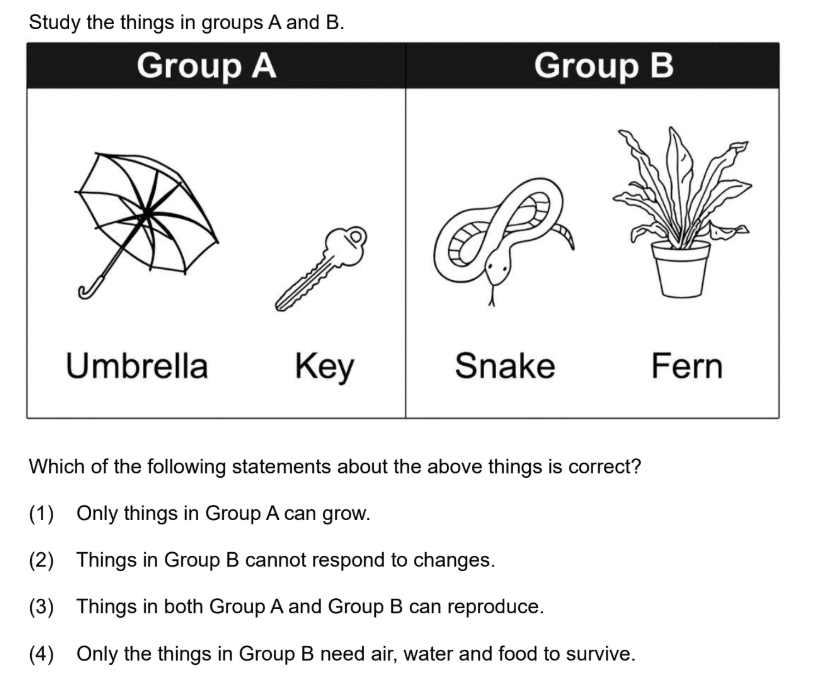
The question shows two groups of things:
- Group A: Umbrella and key
- Group B: Snake and fern
Students are then asked:
Which of the following statements about the above things is correct?
- (1) Only things in Group A can grow.
- (2) Things in Group B cannot respond to changes.
- (3) Things in both Group A and Group B can reproduce.
- (4) Only the things in Group B need air, water and food to survive.
Step-by-Step Solution / Explanation
Step 1: Identify What Is in Group A
Group A contains an umbrella and a key. These are non-living things.
An umbrella and a key do not grow by themselves, do not reproduce, do not need air, water and food to survive, and do not respond to changes in the way living organisms do.
Although an umbrella or key may change in appearance over time, such as becoming rusty, torn, or old, that is not the same as growth. Growth in Science means an increase in size as part of life processes.
Step 2: Identify What Is in Group B
Group B contains a snake and a fern. These are living things.
A snake is an animal, and a fern is a plant. Both have characteristics of living things. They can grow, reproduce, respond to changes, and need air, water and food to survive.
For example, a snake can move away from danger, and a fern can respond to light by growing towards it.
Step 3: Check Statement (1)
Statement (1) says: Only things in Group A can grow.
This is incorrect. Group A contains non-living things, so the umbrella and key do not grow. The snake and fern in Group B are the ones that can grow.
Step 4: Check Statement (2)
Statement (2) says: Things in Group B cannot respond to changes.
This is incorrect. The snake and fern are living things, so they can respond to changes.
For example:
- A snake may move away when it senses danger.
- A fern may grow towards sunlight.
Step 5: Check Statement (3)
Statement (3) says: Things in both Group A and Group B can reproduce.
This is incorrect. Only the snake and fern in Group B can reproduce. The umbrella and key in Group A cannot reproduce because they are non-living things.
Step 6: Check Statement (4)
Statement (4) says: Only the things in Group B need air, water and food to survive.
This is correct. The snake and fern are living things, so they need air, water and food to survive. The umbrella and key do not need these things because they are non-living things.
Final Answer: (4) Only the things in Group B need air, water and food to survive.
Key Concepts Students Must Know
- Living things can grow: They increase in size as part of their life processes.
- Living things can reproduce: Animals and plants can produce young or new plants.
- Living things respond to changes: They react to their surroundings, such as light, touch, danger, or temperature.
- Living things need air, water and food: These help them survive and carry out life processes.
- Non-living things do not have life processes: Objects like umbrellas and keys may change in appearance, but they do not grow or reproduce.
Exam Tips / Common Mistakes
Exam Tips
- First, identify whether each item is living or non-living.
- Use the characteristics of living things to check each option carefully.
- Do not choose an answer just because one part sounds correct.
- Read words like “only”, “both”, “cannot”, and “all” very carefully.
- For plants, remember that they are living things too, even though they do not move from place to place.
Common Mistakes
- Thinking that only animals are living things.
- Forgetting that plants like ferns can grow and reproduce.
- Confusing physical changes with growth.
- Choosing an option without checking all items in both groups.
- Missing important keywords such as “only” and “cannot”.
In Science MCQ questions, one word can change the meaning of the whole statement. That is why students must slow down and compare every option against the concept.
Parent Insight
For Primary 3 students, Science is not only about memorising facts. It is also about learning how to observe, compare, and explain using correct Science keywords.
When practising this topic at home, parents can ask simple questions such as:
- “Is this thing living or non-living?”
- “Can it grow by itself?”
- “Can it reproduce?”
- “Does it need air, water and food to survive?”
These questions help children build confidence and understand the characteristics of living things more clearly.
Conclusion
This P3 Science question teaches students how to classify items correctly by checking whether they are living or non-living.
Group A contains non-living things: umbrella and key. Group B contains living things: snake and fern. Therefore, the correct statement is that only the things in Group B need air, water and food to survive.
Visit our homepage: Click Here…
Read more on our blog: Click Here…
Start here (limited slots weekly):
Free Trial: Click Here…
Enroll: Click Here…
Explore our main tuition brand approach here: Click Here… .