
Introduction
This animal outer covering question is a common Primary Science classification question that tests whether students can match animals to their body coverings correctly. Many students know the words feathers, hair, and scales, but they get confused when the animals are arranged in a table. Once the groups are matched carefully, this animal outer covering question becomes much easier to solve.
The Question / Scenario Explanation
Source: P3 Question 3
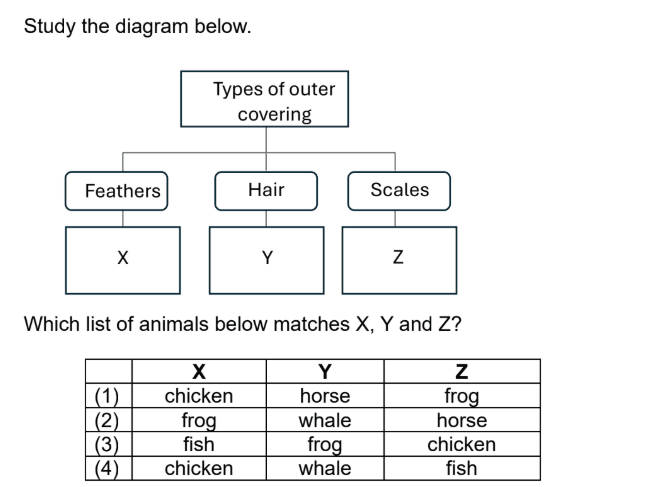
Question (as shown): Study the diagram below.
The diagram shows three types of outer covering:
- Feathers → X
- Hair → Y
- Scales → Z
We need to choose the list of animals that correctly matches X, Y, and Z.
Options:
(1) X = chicken, Y = horse, Z = frog
(2) X = frog, Y = whale, Z = horse
(3) X = fish, Y = frog, Z = chicken
(4) X = chicken, Y = whale, Z = fish
Step-by-Step Solution / Explanation
Step 1: Match feathers to the correct animal
Animals with feathers are birds.
A chicken is a bird, so:
X = chicken
Step 2: Match hair to the correct animal
Animals with hair are mammals.
A whale is a mammal, so:
Y = whale
Even though whales live in water, they are still mammals.
Step 3: Match scales to the correct animal
Animals with scales include fish and many reptiles.
From the options given, the correct animal is:
Z = fish
Step 4: Choose the correct option
So the full matching is:
X = chicken
Y = whale
Z = fish
This matches option (4).
✅ Final Answer: Option (4)
Key Concepts Students Must Know
- An animal outer covering question tests how well students can classify animals by body features.
- Birds have feathers.
- Mammals have hair or fur.
- Fish have scales.
- Science questions often mix familiar animals with less obvious ones, such as whales, to test understanding carefully.
Exam Tips / Common Mistakes
Exam Tips
- Match each outer covering one by one instead of guessing the full option immediately.
- For an animal outer covering question, start with the easiest match first, such as feathers for chicken.
- Check all three boxes X, Y, and Z before choosing the option number.
- Remember that an animal’s habitat does not change its classification group.
Common Mistakes
- Choosing frog for scales, even though frogs do not have scales.
- Forgetting that a whale is a mammal and has hair, not scales.
- Choosing fish for feathers or chicken for scales by rushing through the table.
- Looking only at one column and not checking whether the whole option matches all three coverings.
Parent Insight
This animal outer covering question is a good example of early Science classification. Many children can name animals, but they need practice matching animals to their characteristics accurately. Questions like this build stronger observation and grouping skills, which are useful across many Primary Science topics.
Conclusion
In this animal outer covering question, feathers match chicken, hair matches whale, and scales match fish. Therefore, the correct list is option (4). This question reminds students to classify animals by their body coverings carefully, not by where they live.
Visit our PSLE Science homepage: Click Here…
Read more PSLE Science worked examples here: Click Here…
Start here (limited slots weekly):
Free Trial: Click Here…
Enroll: Click Here…
Explore our main tuition brand approach here: Click Here… .