
Introduction
This grasshopper life cycle question is a common Primary Science MCQ that tests whether students know the stages of incomplete metamorphosis. Many students remember that a grasshopper has a nymph stage, but get confused when asked how many stages there are. Once you understand the sequence of a grasshopper life cycle, this question becomes much easier to answer accurately.
The Question / Scenario Explanation
Source: P6 Question 3
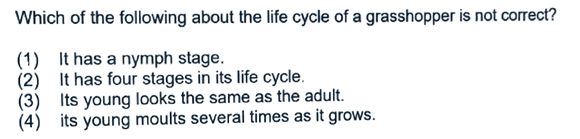
Question (as shown): Which of the following about the life cycle of a grasshopper is not correct?
Options:
(1) It has a nymph stage.
(2) It has four stages in its life cycle.
(3) Its young looks the same as the adult.
(4) Its young moults several times as it grows.
Step-by-Step Solution / Explanation
Step 1: Recall the stages of a grasshopper’s life cycle
A grasshopper life cycle follows incomplete metamorphosis.
The stages are:
- egg
- nymph
- adult
This means a grasshopper has three stages, not four.
Step 2: Identify the incorrect statement
Option (2) says: It has four stages in its life cycle.
This is not correct because a grasshopper life cycle has only three stages: egg, nymph, and adult.
So the incorrect statement is option (2).
✅ Final Answer: (2) It has four stages in its life cycle.
Step 3: Explain why the other options are correct
Option (1) is correct because a grasshopper does have a nymph stage.
Option (3) is correct because the young grasshopper, called a nymph, looks similar to the adult, although it is smaller and not fully developed.
Option (4) is correct because a nymph moults several times as it grows before becoming an adult.
Step 4: Link it to science concept understanding
This question tests whether students can tell the difference between incomplete metamorphosis and complete metamorphosis.
Animals with complete metamorphosis usually have four stages, such as egg, larva, pupa, and adult. But a grasshopper life cycle is different because it does not have larva or pupa stages.
Key Concepts Students Must Know
- A grasshopper life cycle has three stages: egg, nymph, and adult.
- Grasshoppers undergo incomplete metamorphosis.
- A nymph looks like a smaller version of the adult.
- The nymph moults several times as it grows.
- Science MCQs often test whether students can compare complete and incomplete metamorphosis correctly.
Exam Tips / Common Mistakes
Exam Tips
- Underline keywords like not correct so you know you are looking for the wrong statement.
- Recall the exact stages before checking the options.
- For a grasshopper life cycle question, remember that grasshoppers do not have a pupa stage.
- Compare each option carefully instead of choosing based on memory alone.
Common Mistakes
- Choosing option (1) because students forget what a nymph is.
- Thinking all insect life cycles have four stages.
- Confusing incomplete metamorphosis with butterfly life cycles.
- Missing the words not correct and accidentally choosing a true statement.
Parent Insight
This grasshopper life cycle question is a good example of how Science exams test both memory and understanding. Students may memorise terms like egg, nymph, and adult, but still lose marks if they cannot distinguish between different animal life cycles. Practising this type of concept comparison helps children answer MCQs more confidently and improve their scientific reasoning.
Conclusion
In this grasshopper life cycle question, the incorrect statement is option (2) because a grasshopper has three stages, not four. The correct sequence is egg → nymph → adult. Understanding incomplete metamorphosis helps students avoid common Science MCQ traps.
Visit our PSLE Science homepage: Click Here…
Read more PSLE Science worked examples here: Click Here…
Start here (limited slots weekly):
Free Trial: Click Here…
Enroll: Click Here…
Explore our main tuition brand approach here: Click Here… .