
Introduction
When a bulb fuses, it creates a break in the circuit. In this series circuit fault question, all the other bulbs did not light up, which tells us something very important: the fused bulb must have cut off the only working path for electric current.
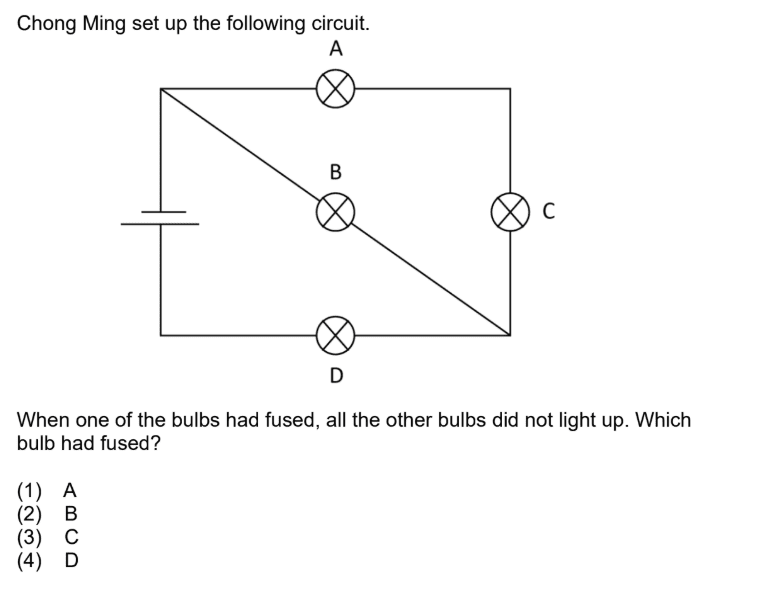
The Question / Scenario Explanation
Source: P5 Question 1
Chong Ming set up the following circuit with bulbs A, B, C and D.
When one of the bulbs had fused, all the other bulbs did not light up.
Which bulb had fused?
Options: (1) A (2) B (3) C (4) D
Step-by-Step Solution / Explanation
Step 1: Understand what “all other bulbs did not light up” means
If every bulb goes off, the circuit is open (broken) and current cannot flow from the battery through the circuit and back.
This usually happens when the fused bulb is on a part of the circuit that everyone depends on (a main path).
Step 2: Look for the bulb that is on the main loop with the battery
In the diagram, bulb D is on the bottom wire of the main rectangular loop and is part of the return path back to the battery.
- If D fuses, the circuit becomes open, and no current can complete the loop.
- Then A, B, and C will also not light up.
Step 3: Confirm using the idea of alternative paths
Bulb B lies on the diagonal branch, which provides an alternative route within the circuit.
So if B fuses, there can still be another route for current through the outer loop (depending on the exact connections). But the key observation is: only a break in the main loop will turn everything off, and that is bulb D.
✅ Final Answer: Option (4) D
Key Concepts Students Must Know
- A fused bulb acts like an open switch (breaks the circuit).
- For all bulbs to go off, the break must be on the main path where current must pass to return to the battery.
- If there is an alternative path (parallel route), not all bulbs will necessarily go off.
Exam Tips / Common Mistakes
Exam Tips
- Highlight the clue: “all the other bulbs did not light up” → circuit is open.
- Identify the bulb placed on the main loop closest to the battery’s full path.
- Ask: “If this bulb breaks, can current still return to the battery?” If no → that’s the answer.
Common Mistakes
- Choosing the bulb that “looks most central” (often B), without checking the main current path.
- Forgetting that a diagonal wire can create an alternate route.
- Thinking bulbs stop others from lighting due to “less electricity” (the real reason is an open circuit).
Parent Insight
This series circuit fault concept helps students answer circuit questions confidently: they learn to trace a complete loop from the battery and spot where a single break would stop everything. Practise with your child by tracing the path using a finger—battery → bulb(s) → back to battery.
Conclusion
In this series circuit fault question, all bulbs went off when one bulb fused, meaning the circuit became open. Bulb D is on the main path needed to complete the loop back to the battery, so if D fuses, no current flows anywhere. Therefore, the answer is Option (4) D.
Visit our Primary Science homepage: Click Here…
Read more Primary Science practice and explanations here: Click Here…
Start here (limited slots weekly):
Free Trial: Click Here…
Enroll: Click Here…
Explore our main tuition brand approach here: Click Here… .