
Introduction
Flowchart questions can feel confusing because students rush and choose the wrong path. This material properties flowchart question is actually very straightforward—just follow each “Yes/No” decision carefully and match the material to what a trampoline needs.
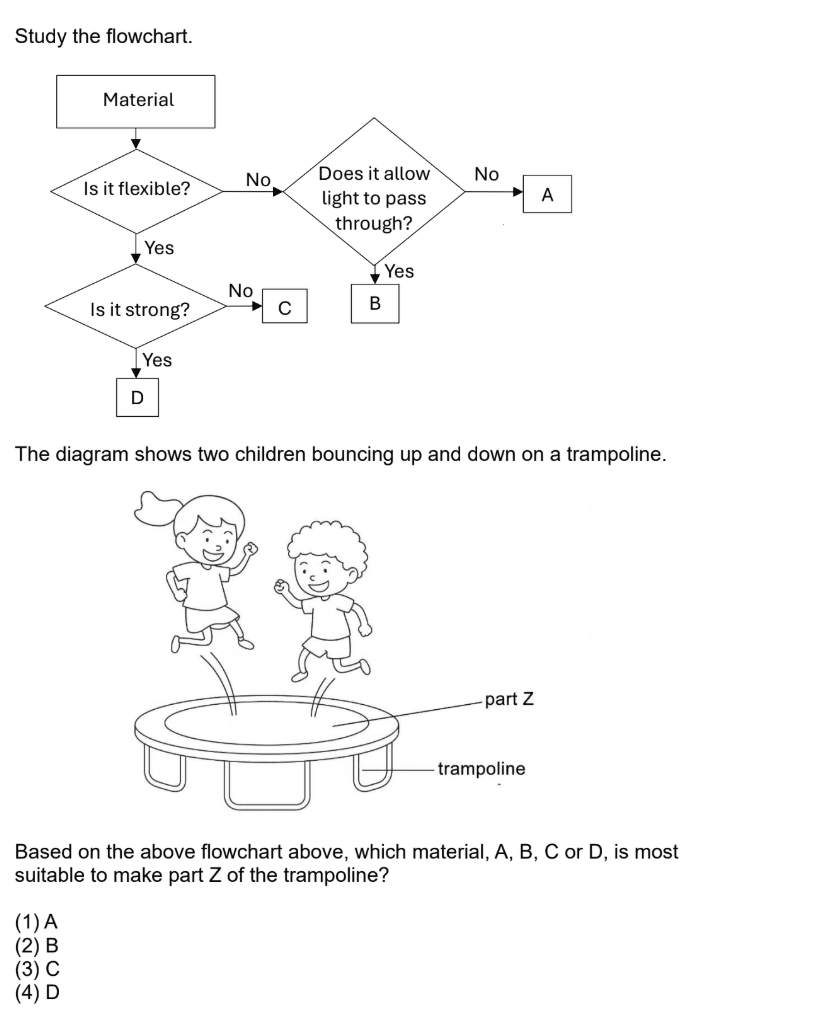
The Question / Scenario Explanation
Source: P3 Question 3
You are given a flowchart that classifies materials using these questions:
- Is it flexible?
- Does it allow light to pass through?
- Is it strong?
The diagram shows two children bouncing on a trampoline. Part Z is the trampoline surface.
Based on the flowchart, which material, A, B, C or D, is most suitable to make part Z of the trampoline?
Options:
(1) A
(2) B
(3) C
(4) D
Step-by-Step Solution / Explanation
Step 1: Decide what properties part Z must have
Part Z is the trampoline surface where children bounce. So it must be:
- Flexible (so it can stretch and bounce)
- Strong (so it can support the children safely)
Step 2: Follow the flowchart path
We start at “Material”.
Question 1: Is it flexible?
For a trampoline surface, Yes (it must be flexible).
So we follow the Yes arrow down to the next question.
Question 2: Is it strong?
For safety, Yes (it must be strong).
So we follow the Yes arrow.
This leads us to Material D.
✅ Final Answer: Option (4) D
Key Concepts Students Must Know
- A material properties flowchart is solved by reading each decision box in order and following the correct arrow.
- For trampoline surfaces:
- Flexible helps it bounce and stretch
- Strong prevents tearing or breaking under weight
- “Allow light to pass through” is not the key property here because trampoline surfaces do not need to be transparent.
Exam Tips / Common Mistakes
Exam Tips
- Before using the flowchart, ask: “What does the object need to do?”
- For trampoline part Z: bounce + support weight → flexible + strong
- Trace the arrows slowly: Flexible (Yes) → Strong (Yes) → D
Common Mistakes
- Choosing a material that is strong but not flexible (it won’t bounce).
- Going to the “light passes through” question even when the first answer should be “Yes, flexible”.
- Not linking the material property to the real-life function of the trampoline.
Parent Insight
This material properties flowchart skill helps students answer many Primary Science MCQs confidently. If your child struggles, train them to do 2 steps every time:
- Identify the function (what the object must do)
- Follow the flowchart path carefully without skipping decision boxes
Conclusion
In this material properties flowchart question, trampoline part Z must be flexible and strong. Following the flowchart: Flexible (Yes) → Strong (Yes) leads to D, so the correct answer is Option (4) D.
Visit our Primary Science homepage: Click Here…
Read more Primary Science practice and explanations here: Click Here…
Start here (limited slots weekly):
Free Trial: Click Here…
Enroll: Click Here…
Explore our main tuition brand approach here: Click Here… .